
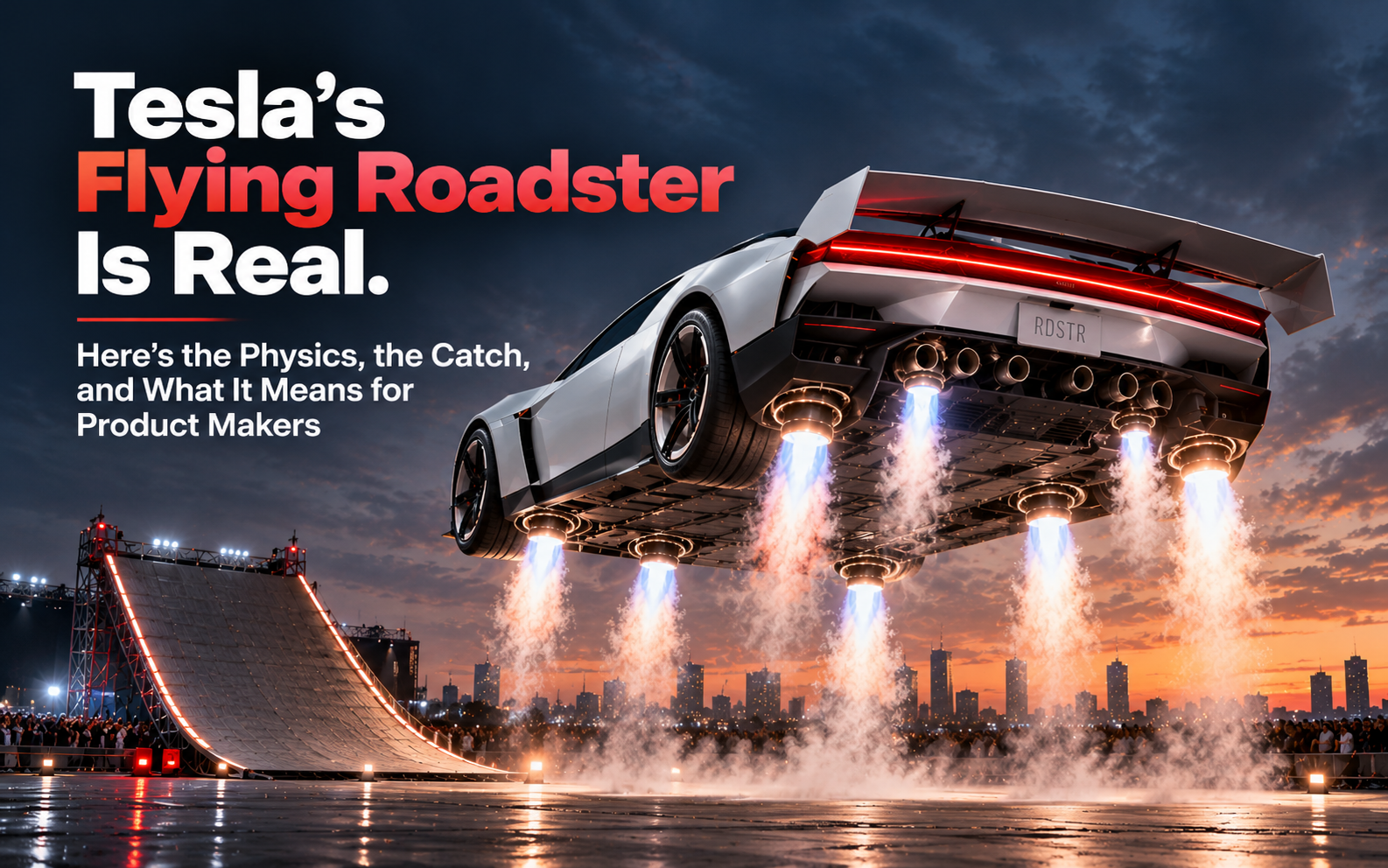
Flying cars have been science-fiction fodder for generations. On October 15, 2026, Tesla revealed its long-delayed Roadster at a launch event in Waco, Texas, and the car took flight using high-pressure gas boosters. The spectacle will dominate headlines, but the more valuable story sits underneath. This is a case study in combining engineering disciplines, managing extreme constraints and turning wild ideas into physical hardware.
This guide covers what Tesla showed, how the technology works, why the car can only hop and spin rather than cruise through the sky, and what product teams can take from it.
What Tesla unveiled
Tesla will offer the Roadster in three trims: "Performance" (road-ready, seats two), "Thrust" (race-ready, seats two, rear cold-gas thrusters) and "Rocket" (air-ready, seats one, ten cold-gas thrusters around the car).
| Trim | Positioning | Seats | Thruster setup |
|---|---|---|---|
| Performance | Road-ready | 2 | Active aero and a suction system |
| Thrust | Race-ready | 2 | Rear-mounted cold-gas thrusters |
| Rocket | Air-ready | 1 | 10 cold-gas thrusters |
Tesla lists about 300 miles of range and speeds above 230 mph for all three. Two caveats shape how seriously to take the "flying" claim. Tesla's website says the flying model is not approved for public road use. And Musk said the car will be built in 2028 but gave no price.
The demo, in plain terms
In the demonstration, the car used a mix of high-powered fans and thrusters to drive up an inverted ramp, spin around and ease itself down to the pavement. It also lifted itself over a Cybercab, Cybertruck, Tesla Semi, Model Y and Model 3 while moving. Notice what's missing: no sustained flight, no cruising altitude. That absence is the key to understanding the technology.
How cold-gas thrusters work
A cold-gas thruster is about the simplest propulsion system in aerospace. Compressed gas sits in a pressure vessel, a valve opens, and the gas rushes out of a nozzle. The escaping gas pushes the vehicle the opposite way. Nothing burns, so the system fires instantly, is easy to control and has few moving parts.
The trade-off is efficiency. Engineers describe this with specific impulse (Isp), which is the thrust you get per unit of propellant used. As a rule of thumb, cold gas delivers an Isp well under 100 seconds, while chemical rockets reach several hundred. In plain words, cold gas burns through its "fuel" quickly for the push it delivers.
A back-of-envelope look at why flights are short
Here is an illustrative calculation. It is not Tesla's data, because Tesla hasn't published these figures.
Tesla's engineering VP said the car uses ten thrusters fed by 600 liters of compressed air. Now assume a hypothetical 1,800 kg vehicle, air stored at about 300 bar, and a cold-gas Isp of about 65 seconds:
- Weight to overcome: about 17,700 N (1,800 kg × 9.81 m/s²)
- Effective exhaust speed: about 640 m/s (65 s × 9.81)
- Airflow needed to hold the car up: about 28 kg every second (17,700 ÷ 640)
- Air in the tanks: about 210 kg (600 L at 300 bar expands to roughly 180 m³ at normal pressure)
- Time to empty the tanks while hovering: under 10 seconds
Even with generous assumptions, a full-weight hover lasts seconds, not minutes. That is why the car performs jumps, flips and controlled landings rather than flying across town. It also explains why Tesla pairs thrusters with "multi-mode" suction and fans: they can add grip and lift assistance without spending the stored air.
The real engineering challenges
1. Safe high-pressure storage. Tesla said every usable void in the car is packed with carbon-fiber overwrapped pressure vessels. These tanks are light and strong, but they are safety-critical and must be designed, certified and inspected rigorously.
2. Control. Ten nozzles must fire in coordinated patterns to lift, rotate and land. That means fast valves, accurate sensors and carefully tuned software. Small timing errors can flip a vehicle that weighs over a ton.
3. Packaging. Every cubic centimeter now competes between battery, tanks, nozzles, plumbing and passengers. Compact routing and light structures matter enormously.
4. Safety and regulation. Musk has been open about this. He acknowledged the Roadster is not necessarily a safety-optimized car. Regulators haven't approved anything like it for public roads.
A fair reality check
Musk has a history of announcing timelines and then missing them. The Roadster was delayed in 2020, 2021, 2023 and 2024, and an October 1 reveal attempt was pushed back by severe weather. Treat 2028 as a target. Axios also noted that it's hard to see what practical purpose a flying sports car serves. The Roadster is best seen as a halo product: it shows what Tesla and SpaceX engineers can do together, not a replacement for your commute.
What this means for product makers and manufacturers
You don't need rockets to benefit from the lessons.
1. Borrow across industries. The Roadster exists because two companies from different fields combined their know-how. Some of your best solutions already exist in another industry.
2. Prototype early, because details break ambitious products. Nozzle housings, ducts, mounts and enclosures rarely fail on the big idea. They fail on clearances, tolerances and assembly. Physical prototypes expose those problems when changes still cost little.
3. Match each process to each part. Not every prototype needs the same method. Here's a practical map for a hardware project like this:
| Component type | Typical prototype route | Why |
|---|---|---|
| Nozzle and duct housings (non-pressure) | SLA or SLS 3D printing | Complex internal shapes, fast iteration |
| Mounting brackets and structural fixtures | CNC-machined aluminum | Strength and tight tolerances |
| Aerodynamic scale or show models | SLA or FDM, then finishing | Smooth surface, fast turnaround |
| Enclosures and covers for pilot batches | Vacuum casting | Low-volume parts without hard tooling |
| Flat panels and brackets | Profile cutting (laser, waterjet) | Fast, accurate flat parts |
4. Design for manufacturing from day one. Wall thickness, draft angles, tolerances and material choice decide whether a part is cheap to make or a headache. A DFM review before production prevents redesign loops.
5. Know the limits of prototyping. Pressure vessels and other safety-critical parts need certified materials, testing and compliance. A printed model is excellent for checking form and fit, but it is never a substitute for certified hardware. Good partners say so clearly.
How Solidus 3D Modeling helps. We work in the stage between idea and production. Our services include production-ready CAD design, reverse engineering of existing parts, 3D printing, CNC machining support, vacuum casting and rapid prototyping. Every engagement can start under an NDA, so your idea stays protected. If you're building an enclosure, duct, bracket, fixture or display model, we can take it from sketch to a part you can hold and test.
Frequently asked questions
Is Tesla's flying car real? Tesla demonstrated a Roadster that lifts and spins using thrusters. It is a demonstration for now, and the flying trim isn't approved for public roads.
How does the Tesla Roadster fly? It releases stored compressed air through multiple nozzles. The reaction force lifts and rotates the car for short bursts.
Why can't it fly for long? Cold-gas propulsion uses stored gas quickly for the thrust it produces. As the calculation above shows, even a generous air supply lasts only seconds at full-weight hover.
When can I buy it? Tesla has said 2028. Given the car's delay history, treat that date cautiously.
What can product companies learn from it? Prototype early, match each part to the right manufacturing process, and review manufacturability before committing to production.
Final thoughts
The flying Roadster is a spectacle, but its real lesson is about method. Combine disciplines, test physically, and manufacture each part with the process that fits its stage and risk. Have a product that needs to go from concept to a working prototype? Get a free consultation and instant quote from Solidus 3D Modeling.
Sources: CBS News, TechCrunch, CTV News and Axios coverage of the October 15, 2026 Tesla event. The physics section is an illustrative estimate, not Tesla data. Details may change as Tesla releases more information.

No replies yet
Start the discussion
Be the first to ask a follow-up question or add practical insight about this topic.