
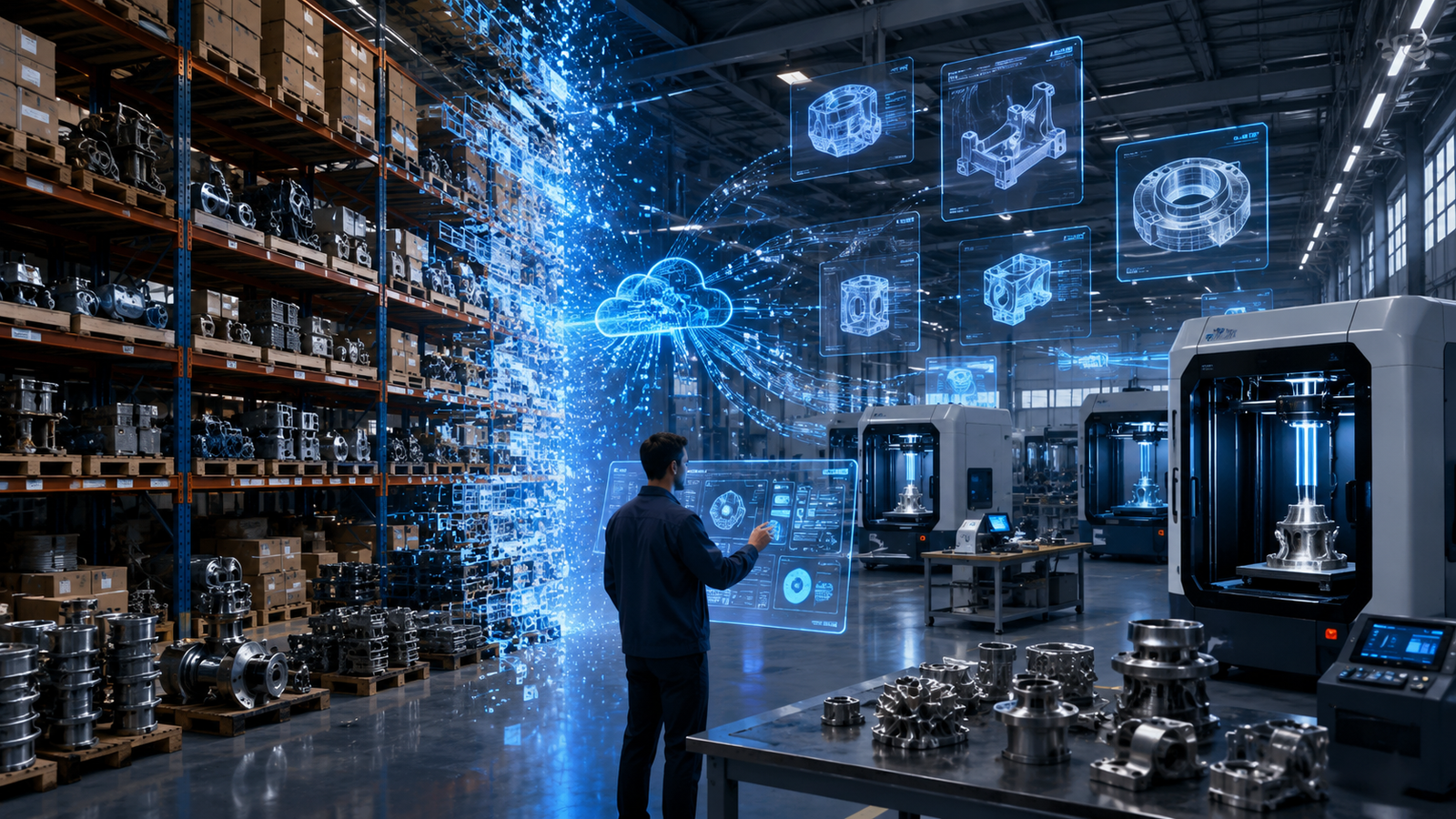
What If Warehouses Could Fit on a Hard Drive?
Imagine walking into a warehouse that contains thousands of spare parts for machines, vehicles, and equipment. Rows of shelves stretch from floor to ceiling, packed with products that may not be used for months—or even years.
Now imagine replacing all those shelves with a secure digital library containing CAD files and manufacturing data. Instead of storing physical parts, companies simply store digital designs and produce components only when they are needed using 3D printing.
This is the concept of Digital Warehousing, and it is rapidly transforming the way businesses manage inventory, spare parts, and supply chains.
As additive manufacturing technologies continue to advance, companies are discovering that they no longer need to keep large inventories sitting idle in expensive warehouses. Instead, they can manufacture parts on demand, reducing costs while improving flexibility and sustainability.
In this article, we'll explore how digital warehousing works, why it's becoming increasingly popular, and how 3D printing is making this transformation possible.
What Is Digital Warehousing?
Digital warehousing is the practice of storing product designs, engineering drawings, and manufacturing files digitally instead of maintaining large physical inventories.
When a customer or maintenance team requires a component, the digital file is retrieved and the part is produced using 3D printing or another suitable manufacturing process.
Instead of storing thousands of physical components, businesses maintain a digital inventory that can be accessed whenever production is needed.
Think of it as the difference between storing physical DVDs and using a streaming service. The content still exists, but it is delivered only when required.
The same principle applies to manufacturing.
Why Traditional Warehousing Is Becoming Less Efficient
For decades, businesses have relied on physical inventory to ensure products and spare parts are available when needed.
While this approach works, it comes with several challenges.
High Storage Costs
Physical inventory requires warehouse space, staff, security systems, insurance, and maintenance.
The larger the inventory, the greater the cost.
Many companies spend significant amounts of money storing products that may never be used.
Capital Locked in Inventory
Every product sitting on a shelf represents money that has already been spent.
Instead of investing those resources into growth, innovation, or operations, businesses often tie up large amounts of capital in inventory.
Digital warehousing reduces this burden by eliminating the need to manufacture parts before they are actually required.
Obsolete Inventory
One of the biggest problems in traditional warehousing is obsolete stock.
Products evolve. Machines are upgraded. Models are discontinued.
Yet warehouses often continue storing parts for products that are no longer actively used.
Eventually, some inventory becomes worthless and must be discarded.
Digital files, however, can remain useful for years without occupying physical space.
Supply Chain Disruptions
Recent global events have highlighted vulnerabilities in traditional supply chains.
Shipping delays, material shortages, geopolitical conflicts, and transportation challenges can all affect product availability.
Digital warehousing offers a more flexible solution by enabling local production when needed.
How Digital Warehousing Works
The process begins with a digital design.
Step 1: Create the CAD Model
Engineers design the component using professional CAD software.
The digital model serves as the master version of the part.
Step 2: Validate the Design
Before the design is stored, engineers verify:
- Dimensions
- Tolerances
- Material requirements
- Manufacturability
- Performance requirements
This ensures the component can be produced reliably whenever needed.
Step 3: Store the Digital Asset
The approved files are securely stored in a digital inventory system.
These files may include:
- CAD Models
- STEP Files
- STL Files
- Technical Drawings
- Manufacturing Instructions
- Quality Standards
Step 4: Produce On Demand
When a customer requests a part, the file is retrieved and sent to a manufacturing facility.
The component is produced, inspected, and shipped directly to the customer.
No physical inventory is required.
The Critical Role of 3D Printing
Digital warehousing would not be practical without modern additive manufacturing technologies.
Traditional manufacturing methods often require expensive tooling, molds, or setup costs.
Producing a single replacement part using conventional methods may be economically impractical.
3D printing changes that equation.
Because parts are built directly from digital files, manufacturers can economically produce:
- One part
- Ten parts
- One hundred parts
without major tooling investments.
This flexibility makes digital inventory a viable business strategy.
Industries Already Using Digital Warehousing
Aerospace
Aircraft manufacturers must support products for decades.
Maintaining physical inventories of every spare part can be extremely expensive.
Digital warehousing allows replacement components to remain available without occupying warehouse space.
Automotive
Many vehicle manufacturers continue supporting older models long after production ends.
Instead of storing thousands of rarely used components, they can maintain digital inventories and manufacture parts when required.
Industrial Equipment
Factory downtime is costly.
Digital spare-part inventories help maintenance teams access critical components faster while reducing storage costs.
Medical Devices
Healthcare equipment often requires specialized replacement parts.
Digital warehousing ensures these parts remain available throughout the product's lifecycle.
Defense and Military
Military equipment may remain operational for decades.
Digital inventories simplify logistics while ensuring critical components remain accessible.
Benefits of Digital Warehousing
Reduced Inventory Costs
Perhaps the most obvious advantage is cost reduction.
Businesses can significantly decrease spending on:
- Storage facilities
- Inventory management
- Insurance
- Material handling
This creates a more efficient use of capital.
Faster Access to Spare Parts
Instead of waiting for components to be shipped from a distant warehouse, parts can often be produced closer to the point of use.
This reduces lead times and minimizes downtime.
Greater Supply Chain Resilience
Digital inventories are not dependent on a single warehouse location.
Files can be accessed globally and produced through distributed manufacturing networks.
This flexibility helps organizations respond more effectively to disruptions.
Lower Environmental Impact
Traditional inventory systems often result in excess production and waste.
Digital warehousing supports sustainability by producing only what is needed.
Benefits include:
- Less material waste
- Reduced transportation requirements
- Lower warehouse energy consumption
- Improved resource efficiency
Extended Product Support
Many products remain in service long after production ends.
Digital inventories allow manufacturers to continue supporting customers without maintaining large stocks of replacement components.
Challenges of Digital Warehousing
Despite its advantages, digital warehousing is not a perfect solution for every application.
Intellectual Property Protection
Digital design files are valuable assets.
Organizations must implement secure storage systems and access controls to protect sensitive information.
Quality Assurance
Every manufactured component must meet design requirements and performance standards.
Robust quality-control procedures remain essential.
Material and Process Limitations
Not every component can currently be produced using additive manufacturing.
Some applications still require traditional manufacturing processes.
However, the range of printable materials continues to expand each year.
The Future of Inventory Management
The manufacturing industry is becoming increasingly digital.
As 3D printing technologies improve and become more widely available, digital warehousing is expected to play a larger role in global supply chains.
Future warehouses may contain fewer physical products and more digital assets.
Manufacturers will increasingly rely on secure digital libraries, distributed production networks, and on-demand manufacturing to meet customer needs.
The result will be more flexible supply chains, lower inventory costs, and improved responsiveness.
Conclusion
Digital warehousing represents a fundamental shift in how businesses manage inventory.
Rather than storing thousands of physical parts that may never be used, companies can maintain digital inventories and manufacture components only when required.
Enabled by advances in 3D printing and additive manufacturing, this approach reduces storage costs, improves supply chain resilience, supports sustainability goals, and provides greater flexibility for spare-part management.
While traditional warehousing will continue to play an important role for high-volume products, digital warehousing is proving to be an increasingly attractive solution for spare parts, low-volume production, and long-term product support.
As manufacturing continues its digital transformation, digital warehousing is poised to become one of the most important innovations in modern supply-chain management.
Frequently Asked Questions
What is digital warehousing?
Digital warehousing is the practice of storing digital manufacturing files instead of physical inventory and producing parts on demand when required.
How does 3D printing support digital warehousing?
3D printing enables manufacturers to create components directly from digital CAD files without requiring large inventories or expensive tooling.
Which industries benefit most from digital warehousing?
Aerospace, automotive, industrial equipment, healthcare, and defense industries are among the biggest adopters.
Is digital warehousing more sustainable?
Yes. It reduces waste, minimizes excess inventory, and lowers transportation and storage requirements.
Is digital warehousing the future?
Many experts believe digital warehousing will become increasingly important as additive manufacturing technologies continue to mature and supply chains become more digitally connected.

No replies yet
Start the discussion
Be the first to ask a follow-up question or add practical insight about this topic.