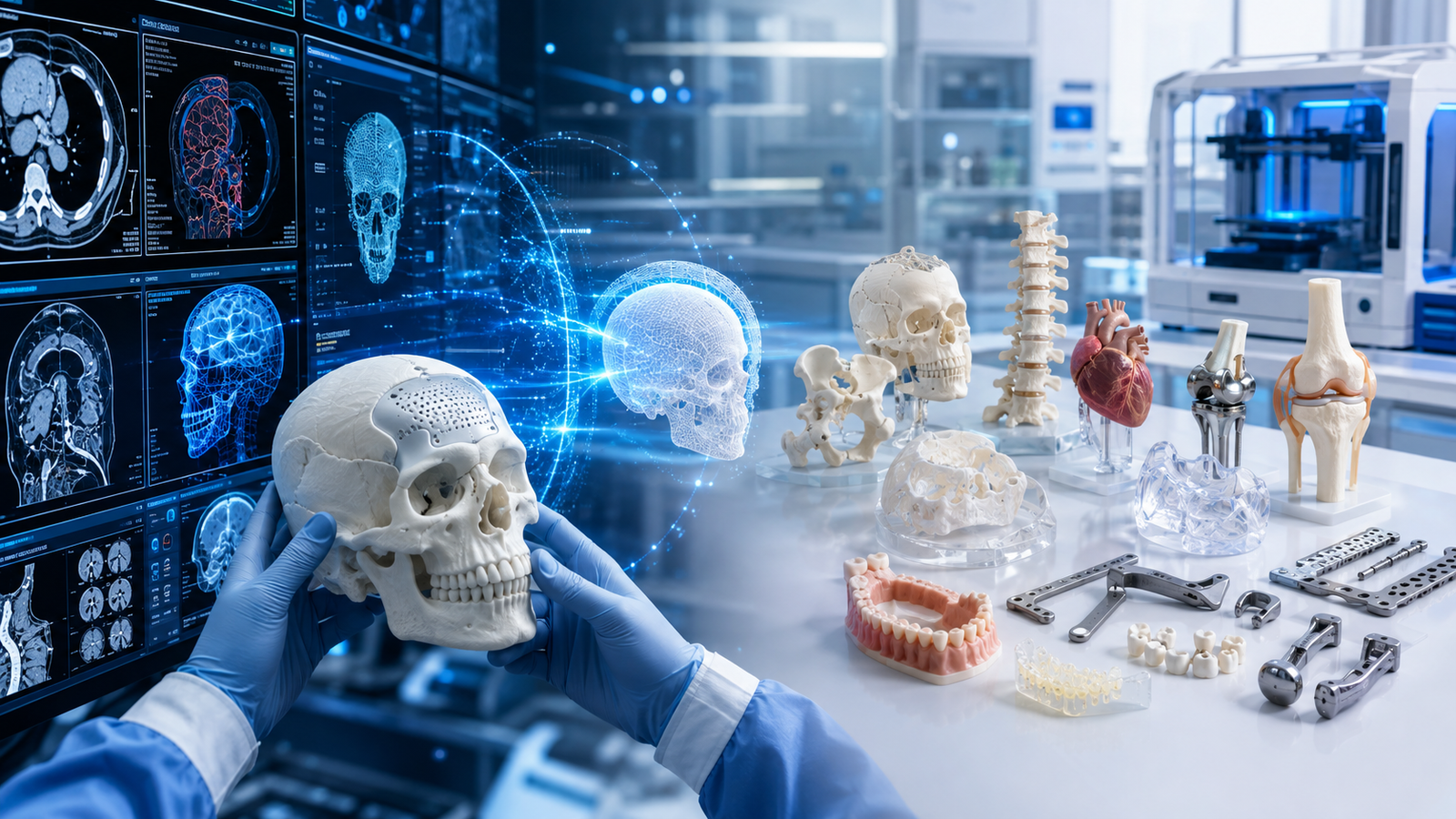
Modern medicine is no longer just about scalpels and stethoscopes — it's increasingly about data turned into physical, touchable objects. A CT scan becomes a 3D-printed skull. An MRI becomes a hand-held tumor model. A drug capsule becomes a life-sized organ replica used to explain a treatment plan to a nervous patient.
At Solidus 3D Modeling, we specialize in 3D CAD modeling, 3D printing, and manufacturing — and one of the fastest-growing areas we work in is surgical models and biocompatible 3D printed products for hospitals, surgeons, medical device startups, dental clinics, and pharmaceutical companies.
This blog breaks down everything you need to know: what surgical models are, which biocompatible materials are used, where they're applied, and why this is also a smart business opportunity — whether you're a clinician, a medtech founder, or a pharma marketing team.
1. What Are 3D Printed Surgical Models?
A surgical model (also called an anatomical model or patient-specific model) is a physical, 3D-printed replica of a body part — bone, organ, blood vessel, tumor, or joint — created directly from a patient's own medical imaging data (CT, MRI, or ultrasound scans).
In simple terms:
- The scan data is converted into a 3D CAD file
- The file is cleaned, segmented, and optimized for printing
- The model is 3D printed in a suitable material (plastic, resin, or metal)
- The surgeon, student, or client now holds an exact physical copy of the patient's anatomy
This is completely different from a generic plastic skeleton you'd find in a classroom. A surgical model is patient-specific — it shows the exact size, shape, and abnormality (like a fracture, aneurysm, or tumor) of one real person.
2. Why Surgical Models Matter — Point by Point
a) Preoperative Planning
Surgeons can physically hold and rotate the exact anatomy before entering the operating room, helping them:
- Choose the right surgical approach
- Pre-size implants and screws
- Anticipate complications
- Reduce time spent on the operating table
b) Patient Education & Informed Consent
Explaining a tumor, fracture, or heart defect verbally is hard. A physical model lets doctors show patients and families exactly what's wrong and what the surgery will fix — improving trust, consent quality, and patient satisfaction.
c) Medical Training & Education
Medical colleges and training hospitals use these models to teach students and residents on realistic, case-based anatomy instead of only textbooks or cadavers.
d) Simulation & Surgical Rehearsal
For complex cases (craniofacial reconstruction, cardiac defects, orthopedic trauma), surgeons can rehearse the actual procedure step-by-step on the model beforehand.
e) Client & Corporate Gifting (Medical & Pharma Industry)
This is an often-overlooked but valuable use case:
- Hospitals gifting a symbolic anatomical model to a donor or partner
- Pharma companies giving branded organ/disease models to doctors as detailing tools
- Medical device companies gifting demo implant models to distributors or investors
- Clinics presenting a "your own scan, 3D printed" keepsake to patients after major surgery (increasingly popular for cardiac, orthopedic, and maternity cases)
f) Pharma & Clinical Trial Communication
Pharmaceutical companies use anatomical and disease-state models to:
- Explain how a drug or device interacts with an organ
- Train sales reps and medical representatives visually
- Support conference booths, investor presentations, and regulatory submissions
- Demonstrate drug delivery mechanisms (inhalers, implants, injectors) on realistic anatomy
3. Biocompatible Materials: What They Are and Why They Matter
Not every 3D printing material is safe for use near or inside the human body. Biocompatibility means a material does not cause a toxic, allergic, or inflammatory reaction when it contacts skin, tissue, or blood.
Two international standards govern this:
- ISO 10993 — the global framework for evaluating medical device materials, covering cytotoxicity, sensitization, irritation, and systemic toxicity
- USP Class VI — the U.S. standard for biological reactivity testing of plastics used in medical settings
A material is only truly "biocompatible" when both the raw material and the printing/post-processing process are validated together — not just the resin or filament on its own.
Common Biocompatible 3D Printing Materials
| Material | Best For | Notes |
|---|---|---|
| Medical-grade PLA / PETG | Anatomical study models, patient education models | Cost-effective, safe for external/non-tissue-contact display models |
| Biocompatible SLA/DLP Resins | Surgical guides, dental models, short-term skin contact tools | High detail, smooth finish, ISO 10993 & USP Class VI certified |
| PA11 / PA12 (Nylon, SLS/MJF) | Prosthetics, orthotics, wearable devices, surgical guides | Strong, lightweight, skin-contact safe |
| PEEK & ULTEM (PEI) | Long-term implants, surgical instruments | High-performance thermoplastics, heat and chemical resistant |
| Titanium & Cobalt-Chrome (Metal 3D Printing) | Permanent implants (orthopedic, dental, cranial) | Printed via laser powder bed fusion (LPBF); requires surface treatment for full biocompatibility |
| TPU-Medical | Flexible wearables, soft tissue simulation | Rubber-like, good for demonstration/training models |
Important note: Biocompatible does not always mean "implantable." Many biocompatible resins are approved only for short-term external or mucosal contact, not permanent implantation. Material choice always depends on intended use, duration of contact, and required certification — this is something we help clients navigate at Solidus 3D Modeling.
4. From Scan to Model: How the Process Works
- Imaging — Patient CT/MRI/ultrasound scan (DICOM file) is obtained
- Segmentation — Software isolates the specific bone, organ, or tumor from surrounding tissue
- 3D CAD Conversion — The segmented data is converted and cleaned into a printable 3D CAD model
- Material Selection — Based on end use (study model, surgical guide, implant demo, gifting piece)
- 3D Printing — Using FDM, SLA/DLP, SLS/MJF, or metal LPBF depending on required strength, detail, and biocompatibility
- Post-Processing — Cleaning, curing, sterilization-compatibility checks, and finishing (painting, coloring different tissues for clarity)
- Delivery — Ready-to-use model for the OR, classroom, clinic, or client presentation
5. Business & Growth Perspective: Why This Market Matters
This isn't just a clinical trend — it's a fast-growing business opportunity for 3D printing and CAD studios like ours, and for the hospitals/companies that adopt it early.
Market signals worth noting:
- The global surgical models 3D printing market is valued in the hundreds of millions of dollars today and is projected to grow at a compound annual growth rate of roughly 12–16% through the next decade, driven by rising adoption in preoperative planning, patient-specific treatment, and medical education.
- The broader 3D printing medical devices market is expected to grow several times over in the coming years, with hospitals and clinics representing the largest share of end users due to increasing point-of-care 3D printing adoption.
- Surgical implants remain the single largest application category, but anatomical models for planning, training, and communication are one of the fastest-growing segments.
What this means for businesses:
- New revenue stream for CAD/3D printing studios — offering medical modeling as a specialized service line (not just prototypes for product design)
- Recurring business potential — hospitals and clinics that adopt patient-specific models tend to need them repeatedly, case after case
- Corporate gifting niche — pharma and medtech companies are actively looking for meaningful, branded, science-based gifting alternatives to generic corporate merchandise
- Medical device prototyping pipeline — device startups need functional and biocompatible prototypes before regulatory testing; this is a natural extension of CAD + 3D printing services
- Faster go-to-market for medtech startups — rapid prototyping cuts design iteration time from weeks to days compared to traditional manufacturing
- Differentiation for hospitals — offering "see and hold your own anatomy" services improves patient trust and can be marketed as a premium, tech-forward care experience
- Cross-selling opportunity — a single hospital or pharma client can need CAD design, prototyping, small-batch manufacturing, and gifting pieces — all under one vendor relationship
6. Who Needs This? (Target Clients)
- Hospitals & surgical departments — preoperative planning models
- Medical colleges & training institutes — teaching models
- Orthopedic, cardiac, and neuro clinics — case-specific anatomical models
- Dental & maxillofacial clinics — surgical guides, implant models
- Medical device startups — functional prototypes before certification
- Pharmaceutical companies — disease-state models, drug mechanism demos, conference/gifting pieces
- Research institutions — anatomical study aids for publications and presentations
7. Why Choose a Dedicated CAD + 3D Printing Partner
Producing a genuinely useful surgical or biocompatible model requires more than "just" a 3D printer. It requires:
- Skilled CAD modeling to clean and prepare imaging data accurately
- Knowledge of which material fits which biocompatibility requirement
- Access to multiple printing technologies (FDM, SLA/DLP, SLS/MJF, metal)
- Post-processing expertise for a clinical-grade, presentation-ready finish
- Fast turnaround for time-sensitive surgical planning
This is exactly where Solidus 3D Modeling fits in — combining 3D CAD design, 3D printing, and manufacturing under one roof to deliver models that are accurate, safe, and ready for real-world clinical or business use.
8. Frequently Asked Questions (FAQs)
Q1. What is a 3D printed surgical model used for? A 3D printed surgical model is used for preoperative planning, patient education, surgical rehearsal, medical training, and communicating complex anatomy to patients, students, or clinical teams. It's built directly from a patient's own CT or MRI scan.
Q2. What does "biocompatible" mean in 3D printing? Biocompatible means a material will not cause a toxic, allergic, or inflammatory reaction when it touches skin, tissue, or blood. Materials are certified biocompatible under standards like ISO 10993 and USP Class VI, and certification depends on both the material and the printing/post-processing method used.
Q3. Which materials are commonly used for biocompatible 3D printing? Common options include medical-grade PLA/PETG, biocompatible SLA/DLP resins, PA11/PA12 nylon, PEEK, ULTEM (PEI), titanium, cobalt-chrome, and medical-grade TPU. The right choice depends on whether the model needs external display use, temporary skin contact, or long-term implantation.
Q4. Are all biocompatible materials safe for permanent implants? No. Many biocompatible resins are approved only for short-term or external/mucosal contact, not permanent implantation. Permanent implants typically require metal 3D printing (titanium, cobalt-chrome) or high-performance thermoplastics like PEEK, along with additional certification.
Q5. How is a surgical model made from a patient's scan? The process involves imaging (CT/MRI), segmentation to isolate the relevant organ or bone, converting that data into a 3D CAD file, selecting an appropriate material, 3D printing, and post-processing (cleaning, curing, finishing) before delivery.
Q6. Can pharmaceutical companies use 3D printed anatomical models? Yes. Pharma companies use anatomical and disease-state models for sales rep training, doctor detailing visits, conference booths, investor presentations, and to demonstrate how a drug or device interacts with the body.
Q7. Why should hospitals or medtech companies outsource 3D CAD modeling and printing instead of doing it in-house? A dedicated CAD and 3D printing partner brings imaging-to-CAD expertise, access to multiple printing technologies (FDM, SLA/DLP, SLS/MJF, metal), knowledge of biocompatibility requirements, and faster turnaround — without the capital cost of building an in-house facility.
Q8. How long does it take to get a custom surgical model made? Turnaround depends on model complexity and material, but patient-specific models for time-sensitive surgical planning are typically prioritized for fast delivery, often within a few days of receiving imaging data.
9. Final Thoughts
Surgical models and biocompatible 3D printed products sit at the intersection of engineering precision and human care — helping surgeons operate with more confidence, helping patients understand their own bodies, and helping pharma and medtech companies communicate complex science in a tangible way.
For businesses in the medical, pharma, and device space, this isn't just a "nice-to-have" anymore — it's becoming a competitive differentiator and a new communication tool.
Want a custom surgical model, biocompatible prototype, or branded anatomical gifting piece for your clients? Get in touch with Solidus 3D Modeling — we'll take your idea from CAD design to a finished, print-ready model.

No replies yet
Start the discussion
Be the first to ask a follow-up question or add practical insight about this topic.