If you've ever needed somewhere between 10 and 200 finished parts — not a single prototype, not a full injection-molded production run — you've probably landed on the same fork in the road: vacuum casting or 3D printing. Both promise speed. Both skip the six-figure cost of hard tooling. And both salespeople will tell you their process is the cheaper one.
The honest answer is that neither process is universally cheaper. Which one wins on cost depends almost entirely on how many parts you need, how complex the geometry is, and what the part actually needs to do once it's made. This guide breaks down where the money actually goes in each process, so you can work out your own break-even point instead of taking anyone's word for it.
What Each Process Actually Involves
Vacuum Casting, Briefly
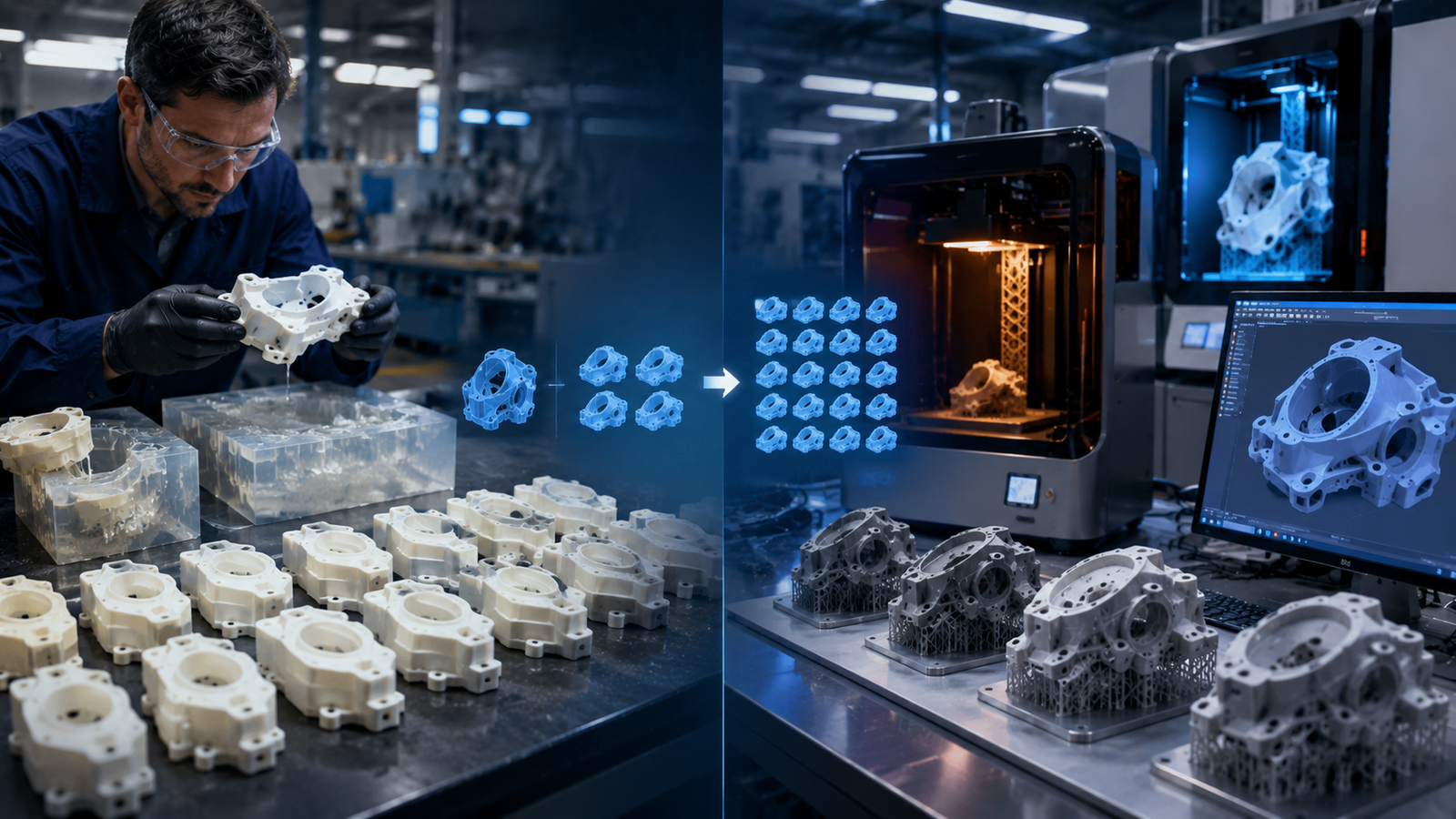
Vacuum casting starts with a master pattern — usually a high-quality 3D print or CNC-machined model. That master is used to create a silicone mold, which is split open, the master removed, and then liquid polyurethane resin is poured in under vacuum to eliminate air bubbles. The result is a cast part that closely mimics injection-molded plastic in look, feel, and mechanical behavior. It's essentially a low-cost, low-volume stand-in for injection molding, which is why it's often called "urethane casting" or "RTV molding" in manufacturing circles.
3D Printing, Briefly
3D printing builds parts directly from a digital file, layer by layer, with no tooling or mold of any kind. For functional low-volume parts, that usually means SLA or DLS resin printing, SLS or MJF nylon printing, or industrial-grade FDM. Every part is printed individually, so the cost and time per part stay fairly constant whether you're making one unit or one hundred.
Where the Cost Actually Comes From
The reason this comparison gets confusing is that the two processes have completely different cost structures. Vacuum casting carries a fixed, upfront tooling cost (the silicone mold) plus a relatively low cost per cast part. 3D printing carries no fixed tooling cost at all, but a comparatively higher cost per part, because each one consumes machine time and material independently.
That single difference explains almost every cost outcome you'll see in this article: vacuum casting gets cheaper the more parts you spread the mold cost across, while 3D printing's cost per part barely changes no matter how many you order.
Upfront tooling cost — Vacuum casting: yes, a silicone mold, typically a few hundred dollars. 3D printing: none.
Cost per additional part — Vacuum casting: low, mainly resin and labor. 3D printing: moderate to high, since every part consumes machine time and material.
Cost behavior as quantity rises — Vacuum casting: drops sharply. 3D printing: stays roughly flat.
Typical mold lifespan — Vacuum casting: around 20–25 casts before the silicone degrades. 3D printing: not applicable, there's no mold to wear out.
Lead time to first part — Vacuum casting: longer, since it needs a master pattern and mold curing. 3D printing: shorter, straight into the print queue.
Lead time for a full batch — Vacuum casting: fast once the mold is ready. 3D printing: scales with printer capacity and part count.
Material range — Vacuum casting: polyurethane resins mimicking ABS, PP, PC, rubber, and glass-filled grades. 3D printing: process-specific, such as PLA/ABS/PETG for FDM, photopolymers for SLA, or nylon for SLS/MJF.
Geometry limits — Vacuum casting: constrained by moldability and undercuts. 3D printing: almost none, internal channels, lattices, and complex shapes are routine.
Out-of-mold surface finish — Vacuum casting: smooth, and can replicate textures, logos, and cosmetic detail. 3D printing: visible layer lines on most processes, often needing post-processing.
A Worked Example: Running the Numbers
Numbers always land better than theory, so here's an illustrative example using a small plastic housing part. These figures are simplified for clarity — your actual quote will move with part size, wall thickness, material choice, and your specific vendor — but the pattern below is consistent with what most manufacturers see in practice.
Assume a silicone mold runs roughly $450, with each cast part adding about $25. On the 3D printing side, assume a flat cost of roughly $55 per part, since per-unit pricing for printed parts doesn't drop much with volume.
At 1 unit, vacuum casting runs about $475 against $55 for 3D printing — 3D printing wins easily.
At 5 units, vacuum casting comes to about $575 against $275 for 3D printing — 3D printing still wins.
At 10 units, vacuum casting comes to about $700 against $550 for 3D printing — 3D printing still wins, by a narrower margin.
At 15 units, both land at roughly $825 — this is the approximate break-even point.
At 25 units, vacuum casting comes to about $1,075 against $1,375 for 3D printing — vacuum casting now wins.
At 50 units, vacuum casting comes to about $1,700 against $2,750 for 3D printing — vacuum casting wins clearly.
At 100 units, vacuum casting comes to about $2,950 against $5,500 for 3D printing — vacuum casting wins by a wide margin.
The crossover in this example lands around 15 units — but treat that number as a rough illustration, not a rule. Smaller, simpler parts push the break-even point lower; large or geometrically complex parts push it higher, since both tooling cost and print time scale with size.
The Catch Most Cost Calculators Miss
There's one detail that simple cost models like the numbers above tend to gloss over: silicone molds wear out. Most vacuum casting molds are good for somewhere around 20 to 25 castings before heat cycling and resin shrinkage degrade the tool enough to affect part accuracy. If your order climbs into the hundreds, you're not paying for one mold — you're paying for several, and that resets part of the cost advantage vacuum casting otherwise builds up at higher volumes.
This is why it's worth asking any vacuum casting vendor directly how many molds your order will actually require, rather than assuming the per-unit price holds steady indefinitely.
Beyond Price: Material and Quality Differences
Cost rarely tells the whole story, and for low-volume production, the differences in material behavior and finish often matter just as much as the invoice.
Polyurethane casting resins are formulated to mimic specific engineering plastics — rigid ABS-like grades, flexible rubber-like grades, glass-filled or flame-retardant variants — which makes vacuum casting a strong stand-in for true injection-molded material properties. 3D printing materials are tied to the process itself: FDM and SLA parts can be noticeably more brittle or UV-sensitive than their cast equivalents, while SLS and MJF nylon parts, though durable, often have a slightly grainy surface texture straight off the printer.
Surface finish follows a similar pattern. Because vacuum-cast parts come out of a mold, they can replicate fine textures, embossed logos, and smooth cosmetic surfaces almost identical to the master pattern — closer to what a customer would expect from a finished retail product. 3D printed parts, depending on the process, usually show some degree of visible layer lines and typically need sanding, bead blasting, or vapor smoothing to reach a comparable finish.
Where 3D printing pulls ahead decisively is geometric freedom. Undercuts, enclosed internal channels, lattice structures, and parts that simply couldn't be pulled from a two-piece mold are routine for a printer and impossible — or at least heavily compromised — for vacuum casting.
Lead Time: Who Actually Gets You Parts Faster
3D printing wins the race to the very first part. There's no mold to build or cure, so a file can often go straight into the print queue within hours of being finalized.
Vacuum casting asks for more patience upfront — building the master pattern and curing the silicone mold typically adds several days before the first cast part exists. Once that mold is ready, though, casting additional units is quick, often just hours apart, which means vacuum casting tends to close the gap — or overtake 3D printing entirely — once you're producing a full batch rather than a single unit.
So, Which One Should You Actually Choose?
If you need 1–10 prototypes or showcase parts, fast, 3D printing is the better fit.
If you need 20–200 parts with consistent, injection-molding-like properties, vacuum casting is the better fit.
If your part has complex internal geometry, channels, or lattices, 3D printing is the better fit.
If you need a rubber-like, flexible, or overmolded feel, vacuum casting is the better fit.
If you're still iterating on the design and expect changes, 3D printing is the better fit.
If you need a market-ready, cosmetic finish with minimal post-processing, vacuum casting is the better fit.
If you're bridging production before committing to full injection-mold tooling, vacuum casting is the better fit.
If your budget realistically allows for only a handful of units, 3D printing is the better fit.
A Few Quick Questions Worth Answering
Is vacuum casting always cheaper than 3D printing at higher volumes? Generally yes, once you clear the break-even point for your specific part — but mold lifespan limits matter, and a part requiring multiple replacement molds can erode that advantage.
Can a 3D printed part be used as the master pattern for vacuum casting? Yes, and it's common practice. A smooth, well-finished 3D print often serves as the master that the silicone mold is built from, combining the design freedom of printing with the per-unit economics of casting.
Do material properties really differ that much between the two processes? Often, yes. Cast polyurethane resins are formulated to closely match specific production plastics, while 3D printed materials are constrained by what each specific printing process can chemically produce — which is worth testing for any part with real mechanical or thermal demands.
The Bottom Line
There isn't a single winner here — there's a crossover point, and it sits in a different place for every project depending on quantity, part geometry, and material requirements. Low quantities and complex shapes tend to favor 3D printing. Mid-range quantities with simpler, cosmetically finished geometry tend to favor vacuum casting. The only way to know for certain where your project falls is to run both numbers against your actual part and order size — which is exactly the kind of comparison worth getting a real quote on before committing either way.

No replies yet
Start the discussion
Be the first to ask a follow-up question or add practical insight about this topic.