The Rise of AI-Generated CAD Files
Designers, engineers, and hobbyists are increasingly using AI tools — from ChatGPT code output to dedicated generative design platforms — to create 3D model files quickly. You type a description, provide some dimensions, and out comes an STL or STEP file, ready to print. Sounds perfect, right?
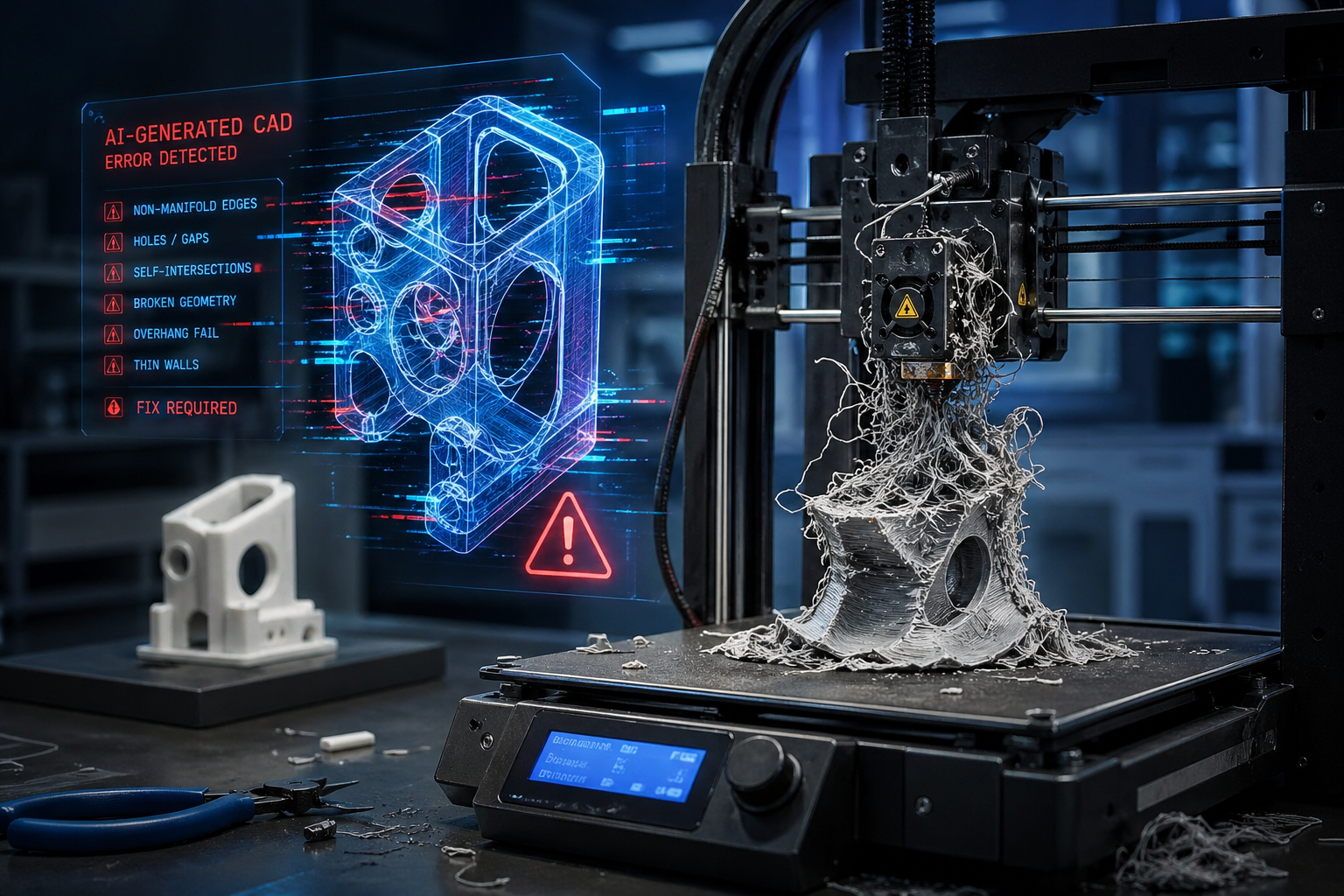
The reality is that most AI-generated CAD files contain geometry errors that make them unprintable or unreliable. The AI produces a file that looks correct on screen but fails the moment you try to slice it or send it to your printer. This is not a niche problem — it affects beginners and professionals alike.
Why Do AI-Generated CAD Files Have Errors?
AI tools are trained on patterns and data — they are excellent at producing something that looks geometrically correct. But they do not understand the strict mathematical rules that define a printable 3D mesh. A 3D printer needs a 'watertight' model — every surface must be perfectly closed, every normal pointing outward, every edge connected to exactly two faces. AI-generated files routinely violate these rules.
Here are the most common errors found in AI-generated CAD files:
1. Open Surfaces / Holes in the Mesh
The model has gaps in its surface, so it is not a closed solid. Slicers cannot determine what is 'inside' the object, causing missing walls or failed prints.
2. Flipped Normals
Some triangles in the mesh face the wrong direction (inward instead of outward), causing slicer software to misread the geometry and produce hollow sections.
3. Non-Manifold Geometry
Edges shared by more than two faces, or faces that meet at a single point — structures that are geometrically impossible to print. This is one of the hardest errors to fix automatically.
4. Intersecting / Overlapping Bodies
Two solid volumes that overlap each other without being properly merged into one unified solid. This causes strange internal voids and wastes material.
5. Incorrect Scale or Units
The AI outputs the file in millimetres when you expected centimetres, or vice versa — resulting in a model that prints at 10x the intended size.
6. Degenerate Triangles
Triangles with near-zero area that add noise to the mesh, confuse slicer algorithms, and increase file size unnecessarily.
What Happens When You Try to Print an Errorful File?
If you have ever sent a file to your slicer only to see it produce a mess of missing walls, strange internal structures, or simply refuse to generate supports — you have almost certainly encountered these errors. The table below shows the typical consequences:
Error Type-What You See-Print Outcome
Open Mesh / Holes- Slicer shows missing walls - Print fails or collapses
Flipped Normals - Model looks inside-out in preview - Hollow sections, bad wall thickness
Non-Manifold Geometry - Slicer throws an error - Incomplete or broken print
Intersecting Bodies - Strange internal voids in preview - Wasted material, structural weakness
Repaired File (Solidus) - Clean, solid preview in all slicers - Successful, high-quality print
Can You Fix These Errors Yourself?
Yes — to an extent. Tools like Meshmixer, Netfabb, PrusaSlicer's repair function, and Microsoft 3D Builder can automatically fix some errors. For simple models with minor issues, these free tools may be enough. However, they have real limitations:
• Automated repair tools often close holes incorrectly, creating flat patches that distort the intended shape.
• They struggle with complex geometry and compound errors.
• For functional parts (brackets, housings, mechanical components), a bad auto-repair can compromise structural integrity or dimensions.
• When multiple error types appear together, free tools frequently produce a technically 'valid' file that still does not print well.
Free auto-repair tools work for simple decorative prints. For functional parts, engineering components, or professional projects, proper manual repair by an expert is the only way to guarantee accuracy and print success.
How Solidus Fixes AI-Generated CAD Files
At Solidus, we specialise in repairing 3D model files — including those generated by AI tools. Our AI Model Repair Service is built for designers, engineers, and businesses who need files that are genuinely print-ready, not just technically 'repaired.'
1. Upload Your File — Send us your AI-generated STL, STEP, OBJ, or other CAD file. We support all major formats.
2. Full Diagnostic Analysis — Our engineers run a comprehensive analysis of your model, identifying every geometry error, scaling issue, and structural problem.
3. Expert Manual Repair — Unlike auto-repair tools, we manually fix each issue while preserving your original design intent. Holes are closed correctly. Intersections are resolved properly. Normals are fixed with precision.
4. Print Validation — We verify the repaired model is watertight, manifold, and correctly scaled — and test it in slicer software before returning it to you.
5. Receive Your Print-Ready File — You get back a clean, repaired file in your preferred format, ready to load into your slicer and print with confidence.
Who Should Use This Service?
Our AI Model Repair Service is ideal for anyone who regularly works with AI-generated or third-party CAD files:
• Product designers and engineers who use generative AI tools for rapid prototyping need parts that actually fit and function — not just look correct on screen.
• 3D printing enthusiasts and Makers who download or generate models and are tired of failed prints will save hours of frustration.
• Manufacturing and production teams who accept customer-provided files need a validation and repair step before committing to machine time.
• Educators and institutions running 3D printing labs deal with a constant stream of student-generated files with errors.
Tips to Reduce Errors in AI-Generated CAD Files
While professional repair is the most reliable solution, here are some steps you can take when generating CAD files with AI to minimise errors from the start:
Be Specific With Your Inputs
The more precise your instructions to the AI, the better the output. Include exact dimensions, specify that the model must be a solid, closed body, and mention what it will be used for (e.g., 'for FDM 3D printing in PLA').
Always Check in a Slicer First
Before printing, open your AI-generated file in PrusaSlicer, Cura, or Bambu Studio. These slicers will flag obvious issues like open meshes and give you a preview of potential problems.
Run a Basic Auto-Repair Pass
For simple models, try the built-in repair tools in Meshmixer or Windows 3D Builder. These catch basic errors and can be a good first pass before sending to a professional repair service.
Know When to Call in the Experts
If your model is complex, functional, or mission-critical — do not rely on auto-repair. The risk of a subtly broken file is too high. That is where Solidus comes in.
Frequently Asked Questions
Can AI really generate usable CAD files?
AI tools are improving rapidly, and some can generate geometry that is close to print-ready. But even the best AI models today produce files with errors a significant portion of the time — especially for complex or precision parts. A repair step is still essential for reliable results.
What file formats does Solidus support for repair?
We support all major 3D file formats including STL, STEP, OBJ, 3MF, IGES, and FBX. If you are unsure whether we support your format, just reach out and we will confirm.
How long does the repair service take?
Turnaround time depends on the complexity of the model and the number of errors present. Simple repairs are typically completed within 24 hours. We also offer an express service for urgent projects.
Will the repair change the look of my model?
Our goal is to preserve your original design intent as closely as possible. We only modify what is broken, and we always document the changes we make. For complex repairs where design decisions are needed, we will consult with you before proceeding.
Is this service only for AI-generated files?
Not at all. We repair 3D model files regardless of origin — AI-generated, manually designed, downloaded from model repositories, or exported from other software. If your file has errors, we can fix it.

No replies yet
Start the discussion
Be the first to ask a follow-up question or add practical insight about this topic.