Table of Contents
- The Problem Every Founder Knows Too Well
- Why "Just Explaining It" Doesn't Work Anymore
- The Psychology of Physical Proof
- What 3D Modeling + 3D Printing Actually Does for Your Pitch
- Traditional Pitching vs. 3D Model Pitching
- Who This Helps (More People Than You'd Think)
- Industry-by-Industry Examples
- How the Process Works, Step by Step
- Choosing the Right Materials for Your Prototype
- Common Mistakes People Make When Pitching Ideas
- How to Choose the Right 3D Modeling & Printing Partner
- Frequently Asked Questions
- The Bottom Line
1. The Problem Every Founder Knows Too Well
You have a brilliant idea. You can see it clearly in your head — the shape, the function, the way it solves a real problem, the way it feels in someone's hand. But the moment you try to explain it to a client or investor using only words, a slide deck, or a rough sketch, something gets lost in translation.
They nod. They say "interesting." They ask a few polite questions. But you can tell — they're not seeing what you're seeing. They're being asked to imagine something they've never encountered, based entirely on your description of it. And human imagination, no matter how willing, has limits.
This is the single biggest gap between a good idea and a funded, approved, or purchased one: the imagination gap. People don't invest in what they can't picture. They don't approve what they can't verify. And no matter how polished your pitch deck is, a flat slide, a 2D drawing, or a verbal explanation can only carry a concept so far.
This is exactly where 3D modeling and 3D printed prototypes change the game — and why more founders, designers, and businesses are treating them not as a "nice to have," but as a core part of how they raise money, land clients, and win approvals.
2. Why "Just Explaining It" Doesn't Work Anymore
Think about the last time someone tried to describe a product to you using only words. Confusing, right? Maybe you nodded along, but you walked away with a fuzzy, incomplete picture — or worse, the wrong picture entirely.
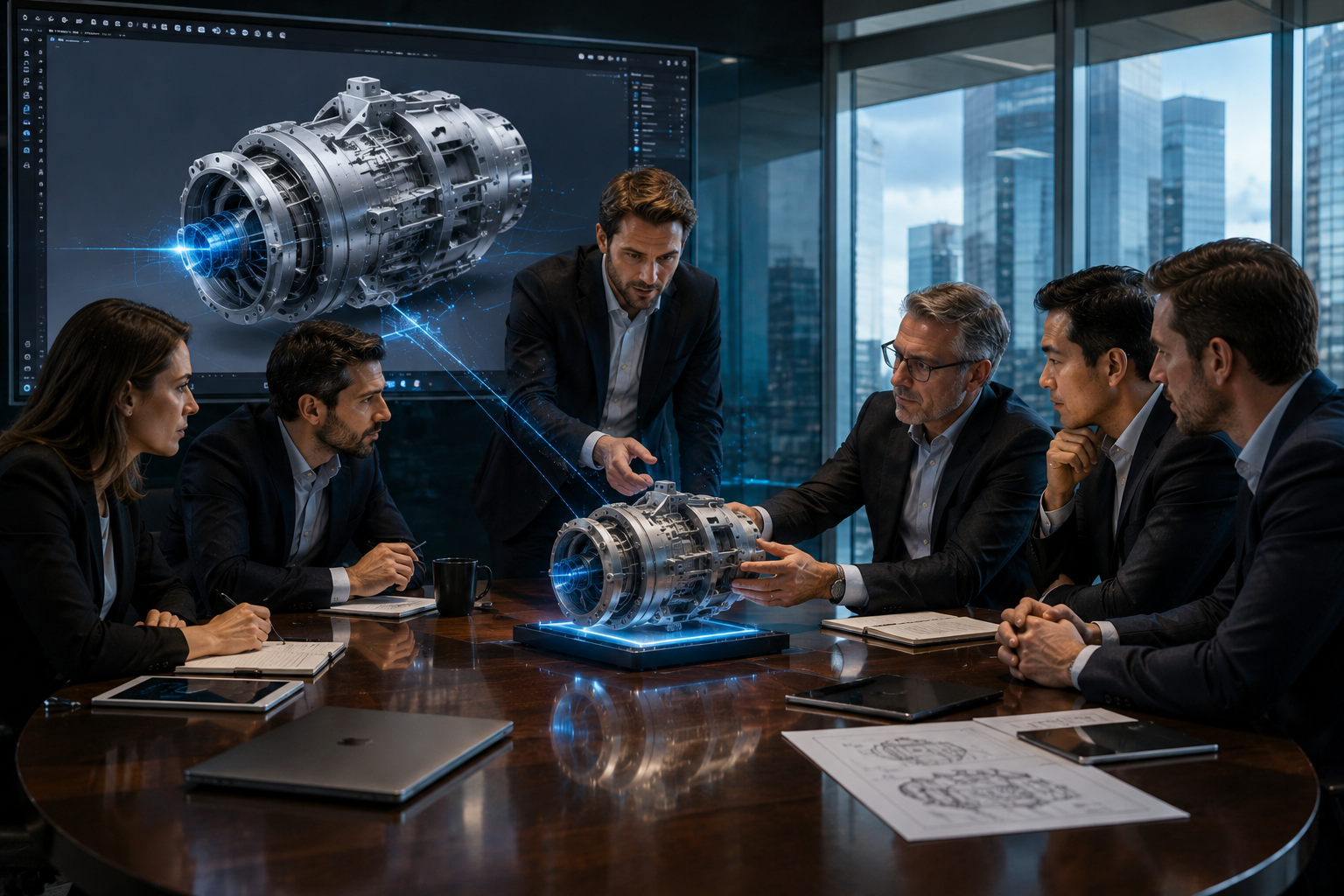
Now imagine that same person instead handed you a physical model you could rotate, inspect, and actually touch. Instantly, the guesswork disappears. You're no longer interpreting — you're evaluating.
There's no comparison between the two experiences, and investors know this instinctively. Most investors and clients aren't skeptical because your idea is weak. They're skeptical because they're being asked to trust your mental image without ever seeing it themselves. A 3D model closes that gap instantly. It turns an abstract pitch into a tangible, believable product — something that exists in the room with them, not just in a slide.
In short: people fund what they can see, hold, and understand — not what they have to imagine.
3. The Psychology of Physical Proof
There's a well-known psychological effect at play here, often tied to how humans build trust through the senses. When someone physically holds an object, their brain processes it as more real, more valuable, and more credible than something they only see on a screen.
This isn't a marketing trick — it's basic human cognition. We are wired to trust what we can touch far more than what we're told. A rendered image can be edited. A verbal pitch can be exaggerated. But a physical prototype sitting on the table has weight, texture, and presence. It can't lie about its own existence.
This is why courtroom lawyers use physical evidence, why real estate developers build scale models of new projects, and why product teams at major companies still 3D print prototypes even after perfecting a digital render. Seeing is convincing. Touching is deciding.
4. What 3D Modeling + 3D Printing Actually Does for Your Pitch
It Makes the Invisible, Visible
A 3D CAD model shows exact dimensions, proportions, mechanisms, and design details long before a single unit is manufactured. Clients see precisely how your product will look, move, and function — not a rough approximation drawn on a whiteboard.
It Builds Instant Trust
When you place a 3D printed prototype in front of an investor, something shifts. It signals: this isn't just an idea on paper — it's real, it's been thought through, and it's ready to move forward. That perception alone can be the difference between "let's think about it" and "let's talk numbers."
It Eliminates Miscommunication
Words are open to interpretation. A 3D model isn't. Whether you're pitching a gadget, a piece of packaging, an architectural concept, a medical device, or an industrial part — the model becomes a shared reference point everyone in the room agrees on, reducing the back-and-forth of "wait, I thought you meant..."
It Speeds Up Decision-Making
Meetings that usually end in "send us more details" often end in "when can we start?" when there's a physical model on the table. Decision-makers move faster when uncertainty is removed, because they're no longer being asked to take a leap of faith.
It Helps You Catch Design Flaws Before They Cost You
3D printing a prototype isn't just for the pitch meeting — it's a genuine design and engineering tool. Ergonomics, scale issues, or assembly problems that are invisible on a screen often become obvious the moment you hold the physical part in your hands. Fixing them now, at the prototype stage, is far cheaper than fixing them after full production has begun.
It Signals Professionalism
Turning up with a real model — not just a sketch or a slide — tells the room you take your own idea seriously. That single impression can shape how seriously they take it too.
5. Traditional Pitching vs. 3D Model Pitching
| Aspect | Traditional Pitch (Slides/Sketches) | 3D Model + 3D Printed Prototype |
|---|---|---|
| Understanding | Relies on imagination | Instant, visual clarity |
| Trust | Built slowly, over time | Built almost immediately |
| Detail Accuracy | Often approximate | Exact scale and proportion |
| Engagement | Passive listening | Hands-on interaction |
| Memory Recall | Easily forgotten | Physically memorable |
| Design Flaws | Often missed until later | Caught early |
| Perceived Readiness | "Just an idea" | "Nearly production-ready" |
The difference isn't subtle. It's the difference between describing a destination and actually taking someone there.
6. Who This Helps (More People Than You'd Think)
- Startups & Entrepreneurs pitching a new product to investors or seed funders
- Product Designers presenting concepts to clients or manufacturers
- Architects & Interior Designers showing scaled building, interior, or space models
- Industrial & Mechanical Engineers validating form, fit, and function before tooling
- Packaging Companies demonstrating new bottle, box, or container designs
- Medical Device Innovators presenting device concepts to stakeholders, hospitals, or regulatory reviewers
- Jewelry & Consumer Product Brands showcasing prototypes before mass production
- Educators & Students presenting design projects or research concepts
- Event & Exhibition Designers pitching booth or installation concepts to sponsors
If your idea has a shape, a 3D model can represent it — and if it needs to be judged, tested, funded, or approved, a 3D printed model can prove it.
7. Industry-by-Industry Examples
Consumer Products: A founder pitching a new ergonomic kitchen tool can hand investors the actual grip shape to hold — instantly answering "does this feel comfortable?" without a single word.
Architecture & Real Estate: A scaled 3D printed model of a proposed building lets clients and city planners understand massing, flow, and scale in ways a floor plan never can.
Medical Devices: A 3D printed housing for a new diagnostic tool allows clinicians to assess handling and ergonomics long before expensive certified manufacturing begins.
Packaging & CPG: Brand teams can physically compare bottle shapes, cap mechanisms, or box structures side-by-side on a shelf mockup, making decisions in a single meeting instead of weeks of email threads.
Industrial Equipment: Engineers pitching a redesigned component to a manufacturing partner can demonstrate fit and assembly with a functional prototype, avoiding costly miscommunication in tooling specs.
8. How the Process Works, Step by Step
- Share Your Concept — sketches, references, rough dimensions, or even just a verbal description of your idea. You don't need finished drawings to start.
- Concept Discussion — our team asks the right questions to understand function, scale, materials, and the purpose of the model (pitch, testing, or both).
- 3D Modeling — your idea is converted into an accurate, professional 3D CAD model, built to real-world specifications.
- Digital Review & Refine — you review a digital render, request changes, and approve the final design before anything is printed.
- 3D Printing — the approved model is printed into a physical prototype, true to scale, proportion, and detail.
- Finishing (If Needed) — sanding, painting, or assembly work to make the model presentation-ready.
- Pitch With Confidence — walk into your next meeting with something your client or investor can actually hold, rotate, and believe in.
Most projects move from concept to a physical prototype in a matter of days, not months — fast enough to fit your actual pitch timeline.
9. Choosing the Right Materials for Your Prototype
Not every prototype needs to be functional — sometimes a visual model is enough to communicate the idea. Other times, you need something durable enough to demonstrate function. A few common options:
- PLA/Standard Resin — ideal for visual presentation models, fast and cost-effective
- ABS/Durable Resin — better for prototypes that need to withstand handling or light functional testing
- Nylon/Engineering-Grade Materials — used when the prototype needs to demonstrate real mechanical function
- Multi-Material/Full-Color Printing — used when color, branding, or texture accuracy matters for the pitch
Your 3D printing partner should help you choose based on what you actually need to demonstrate — there's no reason to over-engineer a model that only needs to look right on a table.
10. Common Mistakes People Make When Pitching Ideas
- Relying only on renders. Digital images are useful, but they don't replace the trust built by a physical object.
- Waiting until the idea is "perfect." Prototypes are meant to evolve — pitching with an early model is far better than not pitching at all.
- Skipping scale accuracy. A model that isn't built to correct proportions can create false impressions and lead to confusion later.
- Ignoring the tactile experience. If your product involves texture, grip, or weight, make sure the prototype reflects that — it's often the deciding factor.
- Not iterating. The best pitches usually go through two or three prototype versions before the final pitch-ready model.
11. How to Choose the Right 3D Modeling & Printing Partner
- Look for a team that asks about your end goal (pitching, testing, manufacturing) — not just "what do you want printed."
- Check if they offer both 3D modeling and printing under one roof, so there's no disconnect between design and execution.
- Ask about turnaround time — your pitch timeline matters, and a partner who understands urgency is essential.
- Review their past work across different industries, not just one niche.
- Make sure they can guide you on material selection based on your actual use case, not just upsell the most expensive option.
12. Frequently Asked Questions
Do I need a finished design before starting? No. Sketches, references, or even a clear verbal description are enough to begin the 3D modeling process.
How long does it take to get a printed prototype? Timelines vary by complexity, but many projects move from concept to physical model within days, not months.
Is a 3D printed model the same as a manufacturing-ready product? Not necessarily. A prototype is built to demonstrate design and function — it's a communication and validation tool, not always a production unit. It can, however, guide the manufacturing process later.
Can 3D printed models be used for functional testing, not just pitching? Yes. Depending on the material chosen, prototypes can be built to withstand handling, movement, and light functional testing.
Is this only useful for physical products? No — it's equally valuable for architecture, packaging, medical devices, and any concept that has a physical shape or spatial component.
13. The Bottom Line
Ideas don't get funded because they're good on paper — they get funded because someone else can finally see what you've been seeing all along. 3D modeling gives your idea a visual identity. 3D printing gives it a physical presence. Together, they remove the guesswork, build instant trust, and turn a hopeful pitch into a confident, credible presentation.
The next time you walk into a meeting to pitch your idea, ask yourself: are you asking them to imagine it — or are you letting them hold it?
Have an idea you're ready to bring to life? Let's turn it into a model your next client or investor won't forget.
-----
Ready to Turn Your Idea Into Something People Can Actually See?
You've got the vision. We'll help you build the proof.
Whether it's your next investor meeting, a client presentation, or just the moment you finally see your idea take physical shape — our 3D modeling and 3D printing team can take you from sketch to prototype in days, not months.
Don't just pitch your idea. Show it.
👉 [Get a Free Consultation] and let's talk about what you're building.
📞 [Contact Our Team] to start your 3D model today.
🌐 [View Our Work] to see prototypes we've built for other founders and businesses. https://solidus3dmodeling.com/

No replies yet
Start the discussion
Be the first to ask a follow-up question or add practical insight about this topic.