If you run a product business, chances are you've looked at China for 3D printing, CNC machining, or bulk manufacturing at some point. It makes sense on paper — lower per-unit costs, huge factory capacity, and a manufacturing ecosystem that can produce almost anything at scale. Thousands of startups, product designers, and procurement teams source from Chinese manufacturers every year, and for good reason.
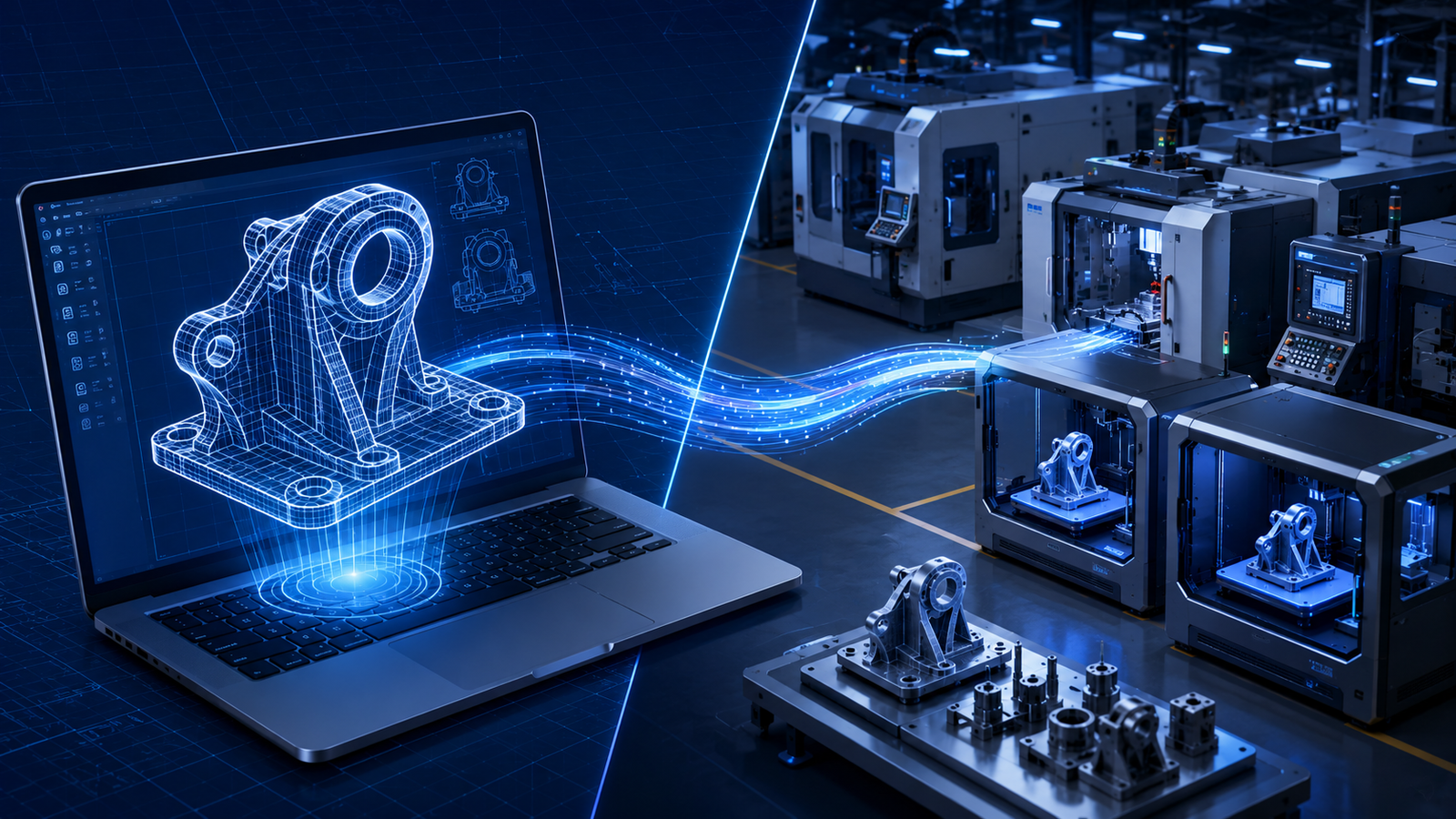
But there's a step that happens before any of that manufacturing can begin, and it's the step most people underestimate: getting your design into a clean, manufacturing-ready CAD file. When that step goes wrong, the rest of the process — no matter how good the factory is — starts to fall apart.
In this article, we'll break down the two most common roadblocks businesses run into when outsourcing manufacturing overseas, why they happen, and how working with a dedicated CAD modeling partner solves both before your files ever reach a factory floor.
Problem 1: Your CAD File Isn't Actually Ready for Manufacturing
Here's something a lot of first-time outsourcers don't realize: a CAD file that "looks fine" on your screen is not the same thing as a file that's ready for 3D printing or CNC machining.
Manufacturing-ready files need to meet very specific technical standards, including:
- Watertight, manifold geometry — no gaps, holes, or overlapping surfaces
- Correct wall thickness for the printing or machining process being used
- Proper tolerances for parts that need to fit together or mate with other components
- Clean, simplified geometry that a CNC machine or slicer software can actually interpret
- The right file format — STEP and IGES for machining, STL or 3MF for most printing workflows
If your file is missing any of this, one of two things usually happens when you send it to an overseas supplier:
- They quietly print or machine it anyway, and you receive a part with sink marks, warping, weak walls, or dimensions that don't match what you expected.
- They flag the issue and ask you to fix it — except now you're stuck, because you don't have in-house CAD expertise to make the correction.
And then there's the situation that's even more common than a "broken" file: not having a CAD file at all. Plenty of businesses come to manufacturing with a hand sketch, a reference photo, an old physical part, or just an idea in their head. A factory isn't a design studio — most manufacturers expect a finished, print-ready or machine-ready file on day one, not a concept that still needs to be engineered.
Problem 2: The Language Barrier Turns Small Issues into Big Delays
Even when your file is technically sound, a second problem shows up fast: communication.
Explaining a tolerance requirement, a finish preference, or a design revision through a language barrier — often across email threads, translated chat messages, and multiple time zones — is genuinely difficult. Small misunderstandings about wall thickness, hole placement, or material specification can turn into weeks of back-and-forth, wasted prototype runs, or parts that technically match the file but not what you actually intended.
This isn't a criticism of Chinese suppliers, many of whom are excellent manufacturers. It's simply a reality of working across a language gap on technical specifications where precision matters down to the millimeter. A single mistranslated requirement in a CAD brief can mean the difference between a part that fits and one that doesn't.
The result is a familiar and frustrating loop:
Confusing file → miscommunicated fix → wrong part → repeat.
Every cycle costs time, money, and trust in the process.
The Real Fix: Get Your CAD Sorted Before It Reaches the Factory
The good news is that this entire problem is solvable, and it doesn't require abandoning cost-effective overseas manufacturing. It requires adding one missing piece to your workflow: a CAD partner who prepares your design correctly before it goes anywhere near a production line.
Here's what that actually looks like:
1. Turning Sketches, Photos, or Ideas Into Real CAD Files
If you don't have a CAD file yet, a professional modeling team can build one from scratch — starting with a hand sketch, a reference photo, a rough description, or an existing physical part. This is often called 2D to 3D conversion, and it's the fastest way to go from "I have an idea" to "I have a file a factory can quote."
2. Reverse Engineering Existing or Legacy Parts
Got an old, discontinued, or worn component you need replicated or redesigned? Reverse engineering recreates that physical part as clean, editable CAD — ideal for obsolete parts, supplier transitions, or redesigns where no original file exists.
3. Repairing and Optimizing Broken CAD Files
If you already have a file but it's failing quotes, printing incorrectly, or getting rejected by manufacturers, a CAD specialist can fix manifold errors, correct wall thickness, simplify overly complex geometry, and export it in whatever format your chosen factory needs — STEP, IGES, STL, OBJ, or native formats.
4. Manufacturability Review Before You Send It Anywhere
A design-for-manufacturability (DFM) check catches problems on your screen instead of on the factory floor — things like undercuts a CNC tool can't reach, overhangs that will fail without support, or tolerances that are unrealistic for the process you've chosen.
5. Clear, English-Language Specs Your Supplier Can't Misread
Once your CAD file is finished, it comes with clear documentation and specifications, removing the guesswork for whichever manufacturer — in China or anywhere else — ends up producing your part. A well-prepared file speaks a universal language that no translation error can distort.
Why This Matters More Than People Think
Manufacturing overseas can absolutely work well for your business. The issue was never the factories — it's the gap between "having an idea" and "having a file a factory can actually run." Close that gap properly, and the rest of the outsourcing process gets dramatically smoother: fewer failed prototypes, fewer confusing email chains, and far less time lost to revisions that could have been avoided with a correct file from the start.
Think of it this way: your CAD file is the instruction manual for your entire manufacturing process. If the instructions are unclear, incomplete, or missing altogether, it doesn't matter how skilled the person reading them is — the outcome will be inconsistent.
How Solidus 3D Modeling Fits Into This
At Solidus 3D Modeling, this is exactly the gap we work in — between your idea and a manufacturer's production line. Whether you're missing a CAD file entirely, working from a sketch or old part, or holding a file that keeps getting rejected by suppliers, our team builds it, fixes it, and hands you a manufacturing-ready file in formats like STEP, IGES, STL, 3MF, and native CAD formats.
We work with:
- 3D CAD Modeling for mechanical parts, assemblies, fixtures, and product housings
- Reverse Engineering for legacy, discontinued, or physical-only parts
- 2D to 3D Conversion from sketches, drawings, and reference photos
- CAD file repair and DFM review before your file goes to any manufacturer
- CNC machining and 3D printing support, including printability checks and export in the exact format your supplier needs
Every project starts with an NDA, so your idea and your intellectual property stay fully protected — before, during, and after we deliver your files. And because everything is handled in clear, direct English communication, there's no translation gap between what you need and what gets built.
If you're outsourcing manufacturing overseas and want the CAD side of the process handled correctly the first time, get a free consultation and instant quote — most projects are quoted within 24 hours.
Have a broken CAD file, a sketch, or just an idea that needs to become a manufacturable part? Talk to our team and we'll figure out the right path from concept to production-ready file.

No replies yet
Start the discussion
Be the first to ask a follow-up question or add practical insight about this topic.