How Solidus 3D Helps Businesses Scale Production: From Prototype to Full-Scale Manufacturing
Bringing a new product to life is exciting. Turning that same product into a reliable, cost-effective, and scalable manufacturing success is where the real challenge begins.
Many businesses successfully develop a prototype, only to discover that manufacturing hundreds or thousands of identical parts introduces entirely new engineering, production, and supply chain challenges. Designs that worked perfectly during development may become too expensive to manufacture, difficult to assemble, or impossible to produce consistently at scale.
This is where many promising products fail—not because the idea isn't good, but because the transition from prototype to production wasn't planned correctly.
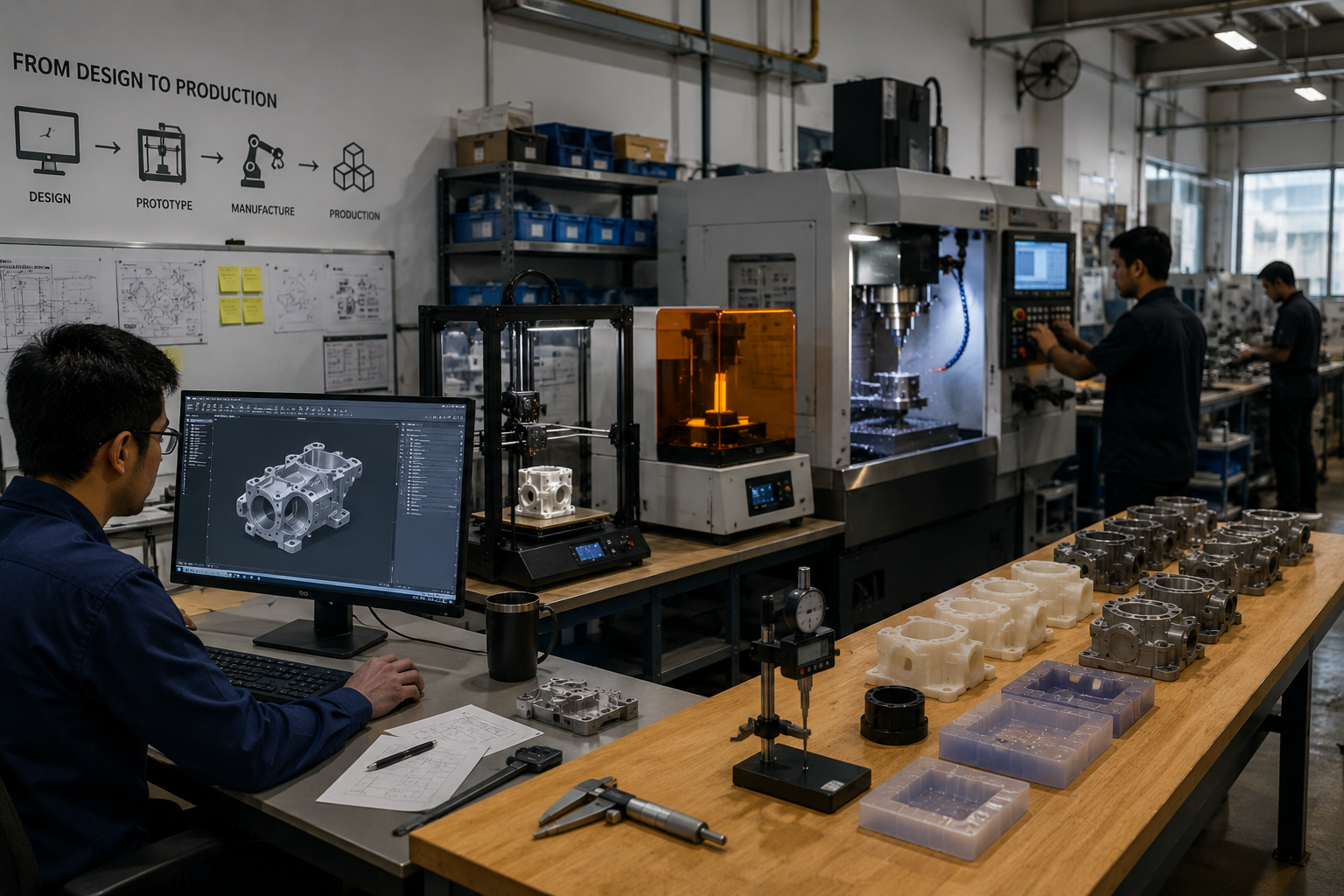
At Solidus 3D, we help businesses bridge this gap. Instead of treating product development, prototyping, machining, and manufacturing as separate stages managed by different suppliers, we provide an integrated engineering and manufacturing workflow that supports every phase of production.
Whether you're developing an innovative consumer product, industrial equipment, automotive component, medical device, or custom mechanical assembly, our team helps reduce manufacturing risks while improving quality, shortening lead times, and optimizing production costs.
Our services include:
- CAD Design & Product Development
- Design for Manufacturability (DFM)
- Reverse Engineering
- Rapid Prototyping
- 3D Printing
- CNC Machining
- Vacuum Casting
- Low-Volume Manufacturing
- Production Support
- Supplier Coordination
By combining engineering expertise with practical manufacturing knowledge, Solidus 3D enables businesses to move confidently from concept to commercial production.
Why Scaling Production Is More Difficult Than Most Businesses Expect
Creating a prototype proves that an idea works.
Scaling production proves that a business works.
These are two completely different challenges.
A prototype is usually built to validate functionality, appearance, or proof of concept. Manufacturing, however, focuses on repeatability, efficiency, quality, and cost control.
As production volumes increase, even minor design decisions can significantly affect manufacturing costs, assembly time, product reliability, and delivery schedules.
For example, a feature that takes only a few extra minutes to machine may seem insignificant for a single prototype. However, when producing 10,000 parts, those additional minutes can translate into hundreds of extra machining hours and thousands of dollars in additional manufacturing costs.
Similarly, material selection, dimensional tolerances, and assembly methods that work well for prototypes may create serious challenges during full-scale production.
Successful manufacturing requires balancing several critical factors simultaneously:
- Product performance
- Manufacturing cost
- Production speed
- Material availability
- Quality consistency
- Ease of assembly
- Supply chain reliability
- Future scalability
Without careful planning, businesses often encounter expensive redesigns after production has already begun.
Common Challenges Businesses Face When Scaling Production
Every industry experiences different manufacturing challenges, but the underlying problems are surprisingly similar.
1. Designs That Cannot Be Manufactured Efficiently
Many CAD models are created with functionality as the primary goal.
Unfortunately, a design that functions perfectly isn't always practical to manufacture.
Common issues include:
- Extremely thin walls
- Deep internal cavities
- Sharp internal corners
- Complex undercuts
- Difficult machining features
- Excessive part complexity
- Poor draft angles for molding
These issues increase manufacturing costs while reducing production efficiency.
Design improvements made early in development are dramatically less expensive than redesigning parts after tooling or production has started.
2. Rising Production Costs
Manufacturing costs don't always decrease as production volume increases.
Choosing the wrong manufacturing process can actually make production significantly more expensive.
For example:
- CNC machining may be ideal for precision components but expensive for high-volume plastic parts.
- Injection molding offers low per-part costs but requires high tooling investment.
- Vacuum casting is often the ideal bridge between prototyping and mass production.
- Industrial 3D printing can eliminate tooling costs entirely for low-volume production.
Selecting the right process for the expected production volume is one of the most important decisions in product development.
3. Quality Inconsistency
As production volumes increase, maintaining consistent quality becomes increasingly challenging.
Small dimensional variations that are almost invisible during prototyping can lead to assembly failures, product defects, customer complaints, and warranty claims when manufacturing thousands of units.
Consistent production requires:
- Tight process control
- Material consistency
- Precision manufacturing
- Thorough inspection
- Standardized workflows
- Experienced engineering oversight
Without these controls, production quality quickly becomes unpredictable.
4. Long Development Cycles
Many businesses lose valuable time by working with multiple suppliers.
A typical product development journey often involves:
- One company for CAD design
- Another for prototyping
- Another for CNC machining
- Another for casting
- Another for production
- Separate logistics providers
Every handoff introduces communication gaps, additional costs, approval delays, and scheduling conflicts.
Instead of accelerating production, businesses spend months coordinating suppliers rather than improving products.
How Solidus 3D Solves Production Scaling Challenges
Scaling production successfully isn't about choosing a single manufacturing process—it's about selecting the right process at the right stage of product development.
At Solidus 3D, we follow an engineering-first approach that minimizes risk, optimizes manufacturing costs, and helps businesses transition smoothly from concept to commercial production.
Instead of simply manufacturing parts, we help clients make informed engineering decisions throughout the entire product lifecycle.
CAD Design & Design for Manufacturability (DFM): Building Products That Are Ready for Production
Every successful product starts with a well-designed CAD model.
However, creating a functional CAD model and creating a production-ready CAD model are two very different things.
Many companies design products based solely on functionality, only to discover later that certain features are expensive, difficult, or even impossible to manufacture efficiently.
This is why Design for Manufacturability (DFM) is one of the most important stages of product development.
Before manufacturing begins, Solidus 3D carefully reviews every CAD model to identify opportunities for improving manufacturability while maintaining the product's intended performance.
Our engineering team evaluates critical factors such as:
- Wall thickness optimization
- Draft angles for molding
- Machining accessibility
- Feature simplification
- Material selection
- Assembly efficiency
- Tolerance optimization
- Weight reduction
- Manufacturing cost reduction
These improvements may seem small individually, but together they can significantly reduce production costs while improving product quality and manufacturing speed.
For example, redesigning a complex component into multiple simpler parts—or combining several components into a single manufacturable part—can dramatically reduce machining time, assembly complexity, and production costs.
By resolving manufacturability issues before production starts, businesses avoid expensive redesigns, tooling modifications, and production delays later in the project.
Rapid Prototyping: Validate Before You Invest
One of the most expensive mistakes a company can make is investing in production before validating its design.
A digital CAD model may appear perfect on a computer screen, but real-world testing often reveals issues that are impossible to identify virtually.
Rapid prototyping allows businesses to test ideas quickly, gather feedback, and improve designs before committing to large manufacturing investments.
At Solidus 3D, rapid prototyping enables clients to evaluate:
- Product dimensions
- Ergonomics
- Fit and assembly
- Functional performance
- Mechanical strength
- Customer feedback
- Design aesthetics
- Manufacturing feasibility
Instead of waiting weeks for tooling or production, prototypes can often be produced within days.
This faster development cycle allows engineering teams to iterate quickly, compare multiple design options, and make informed decisions with minimal risk.
The result is a more refined product entering production, reducing costly engineering changes later in the development process.
CNC Machining: Precision Manufacturing for High-Performance Components
Certain applications demand exceptional precision, tight tolerances, and superior mechanical performance.
In these cases, CNC machining remains one of the most reliable manufacturing methods available.
Solidus 3D provides precision CNC machining for both prototype and production components, using advanced machining processes to manufacture complex metal and plastic parts with outstanding accuracy.
CNC machining is particularly suitable for:
- Functional prototypes
- Precision engineering components
- Automotive parts
- Aerospace components
- Medical devices
- Industrial equipment
- Production tooling
- Low- to medium-volume manufacturing
Compared with additive manufacturing, CNC machining offers excellent dimensional accuracy, superior surface finishes, and material properties that closely match final production requirements.
Whether manufacturing aluminum, stainless steel, brass, engineering plastics, or other materials, CNC machining ensures components meet demanding performance standards while maintaining consistent quality across every batch.
3D Printing: Accelerating Product Development and Low-Volume Manufacturing
3D printing has transformed modern product development by allowing businesses to manufacture complex components without the need for expensive tooling.
Instead of waiting weeks for molds or machining, parts can often be produced in a matter of hours or days.
At Solidus 3D, additive manufacturing is used strategically throughout the product development process—not simply because it's innovative, but because it delivers measurable business value.
Our 3D printing services support:
- Concept models
- Functional prototypes
- Engineering validation
- Design verification
- Jigs and fixtures
- End-use components
- Custom manufacturing
- Low-volume production
- Replacement parts
- Bridge manufacturing
Because no tooling is required, businesses can modify designs rapidly, manufacture customized products, and reduce development costs significantly.
Complex internal geometries, lightweight structures, and intricate features that are difficult—or impossible—to produce using conventional manufacturing methods can often be created efficiently through additive manufacturing.
This flexibility makes 3D printing an invaluable tool for companies focused on innovation, faster product development, and shorter time-to-market.
Vacuum Casting: The Smart Bridge Between Prototyping and Mass Production
Many businesses face a common challenge after completing prototyping.
They need hundreds of production-quality parts—but investing in expensive injection molding tools isn't yet financially practical.
This is where vacuum casting provides the perfect solution.
Vacuum casting uses high-quality silicone molds to produce small batches of components that closely replicate the appearance, surface finish, and mechanical characteristics of injection-molded parts.
It is an excellent choice for:
- Pilot production
- Market testing
- Investor demonstrations
- Product launches
- Functional testing
- Pre-production validation
- Customer samples
- Low-volume manufacturing
Compared with hard tooling, vacuum casting offers significantly lower upfront costs while delivering production-like quality.
Businesses can validate market demand, collect customer feedback, and refine their products before committing to large-scale manufacturing investments.
This approach reduces financial risk while accelerating the transition toward mass production.
Choosing the Right Manufacturing Process Matters
One of the biggest misconceptions in product development is that there is a single "best" manufacturing process.
In reality, every project has unique requirements based on:
- Production volume
- Budget
- Material properties
- Mechanical performance
- Surface finish
- Lead time
- Product complexity
- Regulatory requirements
At Solidus 3D, we don't recommend a manufacturing method simply because it's available—we recommend the process that delivers the best balance of quality, cost, and efficiency for your specific application.
Our engineering team evaluates your product, production goals, and business objectives before recommending the most suitable manufacturing strategy.
This engineering-driven approach helps businesses avoid unnecessary costs while ensuring products are ready for successful commercial production.
Quality Control: Consistency at Every Stage of Production
As production volume increases, maintaining consistent quality becomes one of the biggest challenges for manufacturers.
A prototype may perform perfectly, but when producing hundreds or thousands of parts, even minor variations can affect assembly, performance, durability, and customer satisfaction.
At Solidus 3D, quality is not treated as a final inspection step—it's integrated throughout the entire manufacturing process.
Our engineering team focuses on delivering parts that consistently meet design specifications while minimizing production defects and reducing costly rework.
Quality is maintained through careful attention to:
- CAD model accuracy
- Manufacturing process selection
- Material verification
- Precision machining
- Dimensional inspection
- Surface finish consistency
- Assembly compatibility
- Production documentation
By identifying potential issues before manufacturing begins, businesses can avoid expensive production delays and maintain consistent product quality throughout every batch.
Whether manufacturing ten parts or ten thousand, consistency remains the foundation of successful production.
Supplier Coordination: Simplifying Complex Manufacturing Projects
Many companies underestimate the amount of time required to coordinate multiple suppliers.
A typical manufacturing project may involve:
- Product designers
- CAD engineers
- Prototype manufacturers
- CNC machining vendors
- 3D printing providers
- Casting specialists
- Surface finishing companies
- Packaging suppliers
- Logistics partners
Managing each supplier independently increases the risk of communication errors, scheduling conflicts, inconsistent quality, and unexpected delays.
Instead of spending valuable time coordinating multiple vendors, businesses benefit from working with a single manufacturing partner.
Solidus 3D simplifies the entire production process by coordinating engineering, manufacturing, finishing, and supplier communication under one project management system.
This provides several important advantages:
Single Point of Contact
Clients communicate with one experienced engineering team instead of managing multiple suppliers.
Faster Decision Making
Engineering questions are resolved quickly because design and manufacturing teams work together throughout the project.
Better Quality Control
Consistent engineering oversight ensures every manufacturing stage follows the same quality standards.
Reduced Administrative Work
Businesses spend less time managing suppliers and more time focusing on product development, marketing, and customer growth.
For growing companies, this streamlined approach significantly reduces project complexity while improving production efficiency.
Industries We Serve
Every industry has unique engineering challenges.
Some products require exceptional dimensional accuracy, while others prioritize lightweight design, rapid development, or regulatory compliance.
Because Solidus 3D offers multiple manufacturing technologies, we can recommend the most suitable process for each application instead of forcing every project into a single manufacturing method.
We proudly support businesses across a wide range of industries.
Consumer Products
From household products to wearable devices, consumer goods must balance aesthetics, functionality, manufacturability, and cost.
Our rapid prototyping and low-volume manufacturing services help businesses validate products before full-scale production.
Automotive
Automotive components demand precision, durability, and repeatability.
Solidus 3D supports automotive manufacturers with prototype development, functional testing components, custom fixtures, CNC-machined parts, and production support.
Medical & Healthcare
Medical products require precision engineering and reliable manufacturing.
We assist clients in developing medical device components, equipment housings, testing fixtures, and production-ready parts while maintaining high manufacturing standards.
Industrial Equipment
Industrial machinery often requires custom-engineered components with demanding performance requirements.
Our CNC machining, CAD design, and reverse engineering services help manufacturers maintain equipment, improve existing products, and develop new industrial solutions.
Robotics & Automation
Modern automation systems depend on lightweight, accurate, and reliable mechanical components.
Solidus 3D helps robotics companies accelerate product development through rapid prototyping, precision machining, and production support.
Aerospace & Defense
Aerospace applications require exceptional precision, strict tolerances, and high-performance materials.
Our engineering-first approach supports the development of complex mechanical components while maintaining manufacturing quality and repeatability.
Electronics & Enclosures
From prototype housings to production enclosures, electronic products require accurate dimensions, clean finishes, and efficient manufacturing methods.
We help businesses develop components that are both functional and production-ready.
Why Businesses Choose Solidus 3D
Choosing a manufacturing partner is about more than production capacity.
It is about finding a team that understands engineering, manufacturing processes, cost optimization, and product development.
Businesses choose Solidus 3D because we provide solutions—not just manufacturing services.
Engineering Expertise
Our team understands both product design and manufacturing, allowing us to solve problems before they become expensive.
End-to-End Support
From initial CAD models to production-ready components, every stage of development is supported under one roof.
Faster Time-to-Market
Integrated engineering and manufacturing reduce delays caused by working with multiple suppliers.
Cost Optimization
We recommend manufacturing processes based on your production volume, performance requirements, and budget—not on a one-size-fits-all approach.
Flexible Manufacturing
Whether you require a single prototype, a pilot production run, or ongoing manufacturing support, our services scale with your business.
Reliable Communication
Clear project management, transparent updates, and responsive engineering support ensure projects move forward efficiently.
Manufacturing Process Comparison
Choosing the right manufacturing process depends on your product design, production volume, budget, material requirements, and performance expectations. Each manufacturing method offers unique advantages, making it suitable for different stages of product development.
CAD Design & Design for Manufacturability (DFM)
Best suited for product development and engineering optimization, CAD Design and DFM help identify potential manufacturing issues before production begins. Optimizing the design early reduces production costs, minimizes engineering changes, improves manufacturability, and lowers overall project risk.
3D Printing
3D printing is ideal for concept models, functional prototypes, custom parts, and low-volume production. Since it requires no tooling, businesses can quickly iterate designs, reduce development time, and manufacture complex geometries that are difficult to produce using traditional methods.
CNC Machining
CNC machining is the preferred choice for precision components that require tight tolerances, excellent mechanical strength, and superior surface finishes. It is widely used for functional prototypes, production parts, and components made from metals and engineering-grade plastics.
Vacuum Casting
Vacuum casting is an excellent solution for pilot production, market testing, and small production batches. It produces high-quality plastic parts with production-like finishes while requiring significantly lower tooling investment than injection molding, making it ideal for validating products before mass production.
Reverse Engineering
Reverse engineering is used to recreate accurate CAD models from existing products or legacy components. It enables businesses to redesign obsolete parts, improve existing products, reproduce unavailable components, and prepare designs for modern manufacturing processes.
Choosing the right process at the right stage of product development can significantly reduce costs, shorten lead times, and improve product quality. At Solidus 3D, our engineering team evaluates your project requirements and recommends the manufacturing solution that delivers the best balance of performance, cost, and scalability.
Frequently Asked Questions (FAQs)
1. What is the fastest way to move from a prototype to production?
The fastest approach is to validate your design before investing in production tooling. This typically involves optimizing the CAD model for manufacturability, creating functional prototypes, testing the design under real-world conditions, and selecting the most suitable manufacturing process based on production volume.
At Solidus 3D, we help businesses accelerate this transition by combining engineering, prototyping, machining, and production support into a streamlined workflow.
2. How do I choose between 3D printing, CNC machining, and vacuum casting?
The best manufacturing process depends on your design, production quantity, budget, material requirements, and end-use application.
- Choose 3D Printing if you need rapid prototyping, complex geometries, custom parts, or low-volume production without investing in tooling.
- Choose CNC Machining when your project requires high precision, tight tolerances, excellent surface finishes, or durable metal and engineering plastic components.
- Choose Vacuum Casting if you're producing small batches of production-quality plastic parts for market testing, pilot production, or product validation before investing in injection molding.
3. Can Solidus 3D help improve my existing CAD design?
Yes.
Many products perform well in testing but require engineering improvements before they can be manufactured efficiently.
Our Design for Manufacturability (DFM) review helps identify opportunities to:
- Reduce manufacturing costs
- Improve structural strength
- Simplify assembly
- Optimize tolerances
- Select better materials
- Minimize machining time
- Improve production efficiency
Even small design improvements can significantly reduce overall production costs.
4. What industries does Solidus 3D work with?
We support companies across a wide range of industries, including:
- Automotive
- Consumer Products
- Medical Devices
- Industrial Equipment
- Robotics
- Aerospace
- Electronics
- Product Design
- Manufacturing
- Engineering
Whether you're an established manufacturer or an innovative startup, we provide scalable engineering and manufacturing solutions tailored to your project.
5. Do you support low-volume manufacturing?
Absolutely.
Not every product requires mass production.
Many businesses need:
- Pilot production
- Bridge manufacturing
- Market validation
- Investor samples
- Custom products
- Limited production runs
Our flexible manufacturing capabilities allow businesses to produce the right quantity without investing in expensive production tooling too early.
6. Why is Design for Manufacturability (DFM) important?
A product may function perfectly but still be difficult or expensive to manufacture.
DFM helps eliminate these issues before production begins by optimizing the design for the chosen manufacturing process.
Benefits include:
- Lower production costs
- Faster manufacturing
- Improved product quality
- Reduced material waste
- Easier assembly
- Fewer engineering changes
- Better production scalability
Investing in DFM early can save significant time and cost during manufacturing.
7. Can Solidus 3D manage the entire manufacturing process?
Yes.
Rather than coordinating multiple vendors yourself, Solidus 3D acts as your engineering and manufacturing partner.
We support projects from concept through production by providing:
- CAD Design
- Reverse Engineering
- Product Development
- DFM
- Rapid Prototyping
- CNC Machining
- 3D Printing
- Vacuum Casting
- Supplier Coordination
- Production Support
This integrated approach simplifies project management and improves communication throughout the product lifecycle.
8. Why should I choose Solidus 3D?
Businesses choose Solidus 3D because we focus on engineering solutions rather than simply manufacturing parts.
Our approach combines technical expertise with practical manufacturing knowledge to help clients reduce risk, shorten development time, and scale production efficiently.
Whether you need a single prototype or ongoing manufacturing support, our team works closely with you to deliver reliable, production-ready solutions.
Ready to Scale Your Production with Confidence?
Developing an innovative product is only the beginning. Successfully manufacturing that product at scale requires careful engineering, smart process selection, and a reliable production strategy.
At Solidus 3D, we help businesses transform ideas into production-ready products through integrated engineering and manufacturing services. From CAD design and rapid prototyping to CNC machining, vacuum casting, and production support, we provide the expertise needed to reduce risk, control costs, and accelerate time-to-market.
Whether you're launching a new product, refining an existing design, or preparing for commercial manufacturing, our team is ready to help you move forward with confidence.
Let's Build Smarter Products Together
If you're looking for a trusted engineering and manufacturing partner, Solidus 3D is here to support every stage of your product development journey.
Whether you need:
- Product Design
- CAD Modeling
- Reverse Engineering
- Rapid Prototyping
- CNC Machining
- 3D Printing
- Vacuum Casting
- Low-Volume Manufacturing
- Production Scaling Support
our team can help you choose the right manufacturing strategy for your project.
Contact Solidus 3D today to discuss your requirements and discover how we can help you bring your product to market faster, more efficiently, and with greater confidence.
No replies yet
Start the discussion
Be the first to ask a follow-up question or add practical insight about this topic.